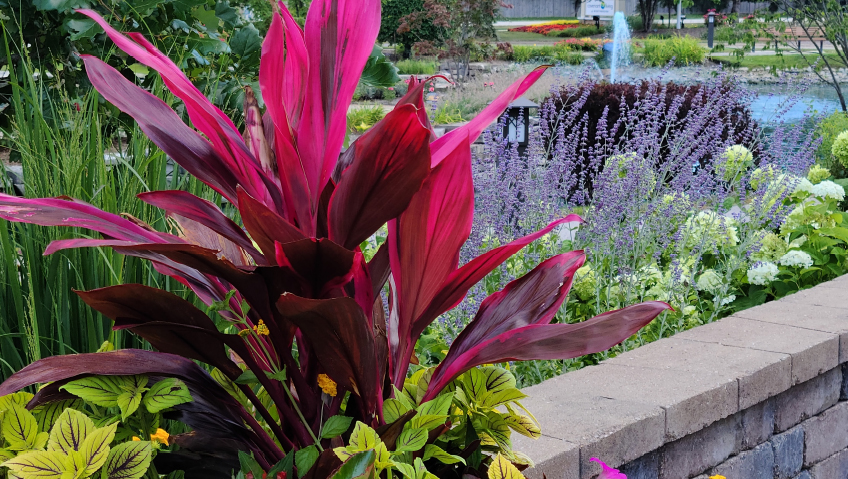
Offering a full range of landscaping services from five branch locations across northern Illinois, southern Wisconsin, and northwest Indiana, Balanced Environments, LLC is one of the region’s largest privately held landscape firms. The company traces its roots to D.R. Church Landscape Company, founded in 1963 by the father of current President and CEO, Bruce Church. From the beginning, the business was built around a simple standard: doing a common thing uncommonly well. Today, that philosophy is reflected in a full team of Designers, Project Managers, Account Representatives, a field staff, and office personnel who support clients across every phase of a project.
Established in the 1990s and officially expanding into commercial landscaping in July 2003, Balanced Environments develops, installs, and maintains award-winning landscapes from its branch locations in Chicago, Lombard, Plainfield, and Old Mill Creek, Illinois, as well as its newest branch in Pewaukee, Wisconsin. What began in three barns on a century-old farm has grown into a company generating $30 million in landscape revenue.
Since its earliest days, the business has evolved into a major commercial landscape contractor. Bruce Church was introduced to the family business at a young age and joined full-time after graduating in 1983. Over time, he modernized and expanded the company with a focus on balancing urban development with well-executed outdoor space design and maintenance.
By the end of the 1990s, Church had grown the company to $15 million. His involvement in the Associated Landscape Contractors of America (ALCA) and its Exterior Landscape Division Board also exposed him to broader industry collaboration, purchasing power, and operational scale. “I met some really intelligent and successful people from all over the country—great entrepreneurs, great minds, like minds,” he says of the experience. Church went on to write a white paper that was presented to Notre Capital in Houston, Texas, a group looking to create a national presence in landscaping.
Shortly thereafter, in 1998, seven companies joined forces to launch LandCare USA. Church instantly became a director of the NYSE-listed company, which expanded from $135 million to $330 million in nine months. Meanwhile, TruGreen/Chemlawn, a division of ServiceMaster, another publicly traded company, was following a similar strategy. After nine months operating as LandCare USA, ServiceMaster offered to purchase LandCare USA. The sale was completed in 1999.
Church continued managing his original branches during the buyout process, but decided to move on when the newly combined company (TrugGreen/LandCare) wanted to close the Milwaukee and Indianapolis locations. He then bought a concrete framing and forming company, R/C Concrete Concepts, with a partner, Gary Rabine of Rabine Paving. After a year, Gary wanted to expand his business and Bruce bought his partner’s ownership shares. By the time the housing market crash of 2008 hit, he had grown the new company from $2 million to $8 million and had changed the name to Hard Surface Solutions (HSS), to better reflect the services the company was offering to his commercial clientele. He had also launched Balanced Environments a month after his trade restriction in the landscaping business ended in 2003. As HSS was already serving many of the same clients that Balanced Environments would serve, Balanced hit the ground running, quickly gaining traction through those existing relationships.
Expansion followed. Today, Balanced Environments operates from offices in Illinois and Wisconsin, supported by satellite locations in Rockford, Madison, Aurora, and Joliet, Illinois and Highland, Indiana, while its sister company, HSS, earns around $10 million annually and brings additional hardscape and concrete capabilities to the group.
The company has also invested heavily in technology to improve operations and responsiveness. Balanced Environments uses ASPIRE Landscape, an end-to-end business management platform designed specifically for commercial landscape management, construction, and snow removal, and pairs it with GPS tracking and other tools to improve scheduling, accountability, and communication. Church says the platform has helped position the company among the top landscape firms nationwide.
Vice President of Sales and Marketing, Gayle Kruckenberg, says creativity is central to the company’s work, but always with a practical purpose. The goal is not just to install attractive landscapes, but to create outdoor spaces that work for the property, the people using it, and the long-term maintenance plan. “Whether the grass is green or not, I want the buildings we service to shine in full color,” she says. “I want them to shine during the day. I want them to shine during the night.” That approach helps Balanced Environments serve a wide range of clients, from building owners and managers to general contractors who need reliable bid-build support.
The company’s team includes around 280 people at peak season and about 75 full-time employees. Balanced Environments emphasizes self-performance whenever possible, using few outside contractors to maintain quality control, continuity, and stronger client relationships. That structure is especially valuable on commercial projects, where schedule discipline and coordination matter as much as design.
One of the company’s most notable projects is River Point public garden, located at 444 West Lake Street in downtown Chicago. Built as a rooftop garden over six sets of railroad tracks with only four inches of soil, the project required technical precision and careful execution. The garden’s 32’ tall Constellation sculpture in red aluminum by Spanish-Swiss architect, Santiago Calatrava, is flanked by fairy-lit trees and verdant lawn. “More than 3,000 couples get engaged annually underneath that statue,” Kruckenberg shares. The finished space combines landscape design, hardscape elements, and public use in a way that has made it a recognizable downtown destination.
Balanced Environments’ work has earned more than 20 awards since 2011, including two gold awards in 2022 for River Point and a Lake County corporate facility in Deerfield, Illinois. The company has also been recognized for projects at Rosalind Franklin University in North Chicago and the Village at Victory Lakes, a senior living community in Lindenhurst, Illinois. Those honors reflect the team’s ability to deliver landscapes that are not only visually strong, but also built to perform over time.
“We have a beautiful portfolio of award-winning properties that we’re so proud to be a part of,” Kruckenberg adds, noting that educators would do well to instill in children a love of gardening. “If we don’t have any horticulturalists, we won’t be able to feed the world,” she continues.
This global perspective underpins the company’s commitment to community, another key facet of its identity. Balanced Environments participates in Habitat for Humanity’s annual women’s build, supports children in need, and works with institutions such as the College of DuPage and Heartland College to help develop the next generation of landscape professionals. Kruckenberg also speaks to schools about careers in the industry and in March 2026, the team took part in the National Association of Women in Construction (NAWIC), Chicago Chapter’s, Camp NAWIC. This year, they welcomed five girls from Chicago’s public school district to experience what it means to be a landscaper for a day at River Point. The final project of the day was to design and plant the spring flower rotation, and the event also explored the more strategic side of the industry, including how unions operate and collaborate, as well as the challenges landscapers face as the final trade on a construction site—often inheriting tightened budgets and timelines that demand creative thinking and problem-solving.
The company also offers consultation services for project owners facing challenging site conditions or coordination issues. In addition, Balanced Environments designs and maintains rooftop and vegetable gardens for community/building tenant sharing purposes and local restaurants, complete with beekeeping. For clients, this breadth of expertise means one partner can handle landscape construction, maintenance, tree care, irrigation, and snow removal, all under one roof.
That full-service model is especially important in a region shaped by harsh winters, freeze-thaw cycles, and changing climate conditions. Balanced Environments draws from generations of experience and an intimate knowledge of the region’s climate patterns. Kruckenberg explains that Northern Illinois, Indiana, and Southern Wisconsin share a uniquely harsh winter environments shaped by Lake Michigan, where repeated freeze-thaw cycles severely limit the range of plants able to thrive—making it one of the most restrictive planting regions in the country.
Illinois also has a high tornado count, with 56 tornadoes having hit the state by March this year. Driven by what is referred to as moisture pools, this makes plant survival increasingly tough. Balanced utilizes creative solutions, such as spraying organic oils for foliage protection on large evergreens and adding gypsum to the soil to better support turf roots in a more ecologically sustainable way, safeguarding water sources from chemical contamination. These changing climates are also the reason Balanced opened its own Tree Care and Irrigation Divisions. Once you add Snow Removal to the basket of services performed, Balanced truly offers a 12-month relationship opportunity and “One Stop Shopping” for its incredibly busy clients.
Church says the company’s approach remains straightforward: clients bring a goal and a budget, and the team builds a program around both. That focus on communication, self-performance, and dependable execution has helped Balanced Environments grow through changing markets while staying true to its core values of Respect, Service, Value, and Pride (RSVP).