Scaffolding plays an essential role in the construction industry and can make the difference between life and death for the workers who rely upon it. Skyline Scaffold Ltd. of Delta, British Columbia, is a leading operator within this vital niche. Skyline supplies scaffolding for a wide range of civil, industrial, and commercial construction projects and counts general contractors, private owners, Indigenous groups, and government organizations among its clients.
There have been some huge developments since we last spoke with Skyline Scaffold for the February 2019 edition of Construction in Focus. The company has since introduced a lightweight, innovative truss system and played a key role in the mammoth stal̕əw̓asəm Bridge construction project.
The bridge was named in recognition of First Nations’ historical and current connections to the area, and can be understood as “a space where you can view the river” or “Riverview.” The new four-lane bridge replaces the Pattullo Bridge and is 1,235 meters (4,051.83 feet) long and spans the Fraser River, connecting the cities of Surrey and New Westminster in Metro Vancouver.
Open to four lanes of traffic since February of this year, it cost $1.637 billion and the project was delivered by Transportation Investment Corporation, a British Columbia crown corporation. Construction began in 2021, near the existing Pattullo Bridge, which was destined to be replaced. The Pattullo Bridge has been decommissioned and will be removed by the end of 2027.
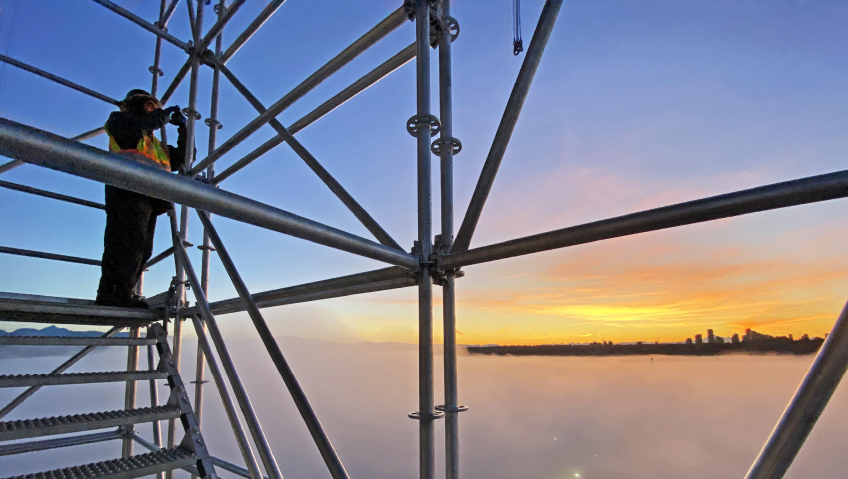
Skyline supplied and erected scaffold systems during the four-and-a-half-year construction period. The company’s most stunning contribution was an eye-popping central stair tower that eventually rose over 510 feet in the air. Just walking to the cable access work platforms at the top of the tower could take half an hour.
“The whole city was watching our scaffold,” says Skyline’s Occupational Health and Safety Manager, Margaret Siccama, with pride.
The central tower was put together by hand, section-by-section. Adding to the challenge was the fact that company staff had to perform their duties above other work crews as well as pier traffic and had to deal with strong winds and unpredictable weather. In addition, this high-profile project came with strict environmental requirements that prohibited any debris from entering the Fraser River, so for environmental and safety reasons, all work-related and personal gear was tied off and secured.
Skyline used a multi-level, high-precision, interlocking palm brace system to attach the central stair tower to the bridge column wall. The company employed 20’ strongbacks—metal beams used in construction to brace walls or structures—for added support. Assembled at ground-level for safety and quality oversight, the strongbacks featured steel plates secured with steel bolts. They were lifted by cranes to cantilevered scaffold platforms then connected to coiled rods previously embedded in the concrete bridge structure. For added security, steel and aluminum tubes were used to further affix the strongbacks to the central stair tower.
Since walking gear up the central stair tower would be an exhausting process, a custom-designed crane-suspended material crib was engineered for crews to use. In a similar fashion, a manlift basket, also supported by a crane, hoisted materials and workers up and down in speedy fashion.
Other substantial projects Skyline Scaffold has worked on recently include the Broadway Subway Line—an extension of the Millennium Line Skytrain in Vancouver—an Amazon warehouse in Richmond, BC, and Vancouver International Airport.
For its projects, the company continues to favour top-of-the-line scaffold components from German manufacturer Layher, including access scaffolding and stairway towers, scaffolding decks, and the Keder XL Roofing System. The Keder System, which protects workers from inclement weather, is easy to assemble and can reach spans of nearly 145 feet. The company also uses steel tie-in anchors to reduce the likelihood of rust.
The team is also extremely excited about the new IXI Truss system. Made from tough but lightweight aluminum, the IXI Truss weighs just 18.5 kilograms (40 pounds). It comes in modular sections measuring one, two, and three meters (3.2, 6.5, and 9.8 feet) in length, and is 120 cm (40.7 inches) high. The system is designed for quick connection, and is easy to assemble, corrosion-resistant, and has a high load capacity.
The IXI Truss concept was developed by Optimal Access Solution, a company run by Skyline’s Founder and Chief Executive Officer Arka Chorbajian. An Italian company called Pilosio manufactured the system, which Skyline is now distributing. Pilosio displayed the IXI Truss at the bauma industry trade show in Munich last year.
The ring-lock compatible IXI Truss was developed through “a hands-on collaboration that merges innovation with real-world site knowledge and introduces a new benchmark for high-capacity truss design,” says Chorbajian.
The company has embraced the IXI Truss “big time,” and is delighted that the product is such a success, says Siccama. “We can’t keep them in stock. They are selling so quickly.”
She cites versatility as one of the IXI Truss’ main attributes, as the system can be used to create pedestrian bridges, transit walkways, load bearing structures for temporary roofs, railway access bridges, and temporary connections between buildings or structures.
One thing that has not changed is the company’s geographic focus. It remains firmly entrenched within the Lower Mainland of BC and rarely takes jobs outside of this region—and there is good reason for this: “We’ve got so much work, we couldn’t leave if we wanted to,” notes Siccama.
Indeed, Skyline has grown considerably since it was founded by Chorbajian in 1994. In its early days, the young firm was a four-person operation working from a single pickup truck. Today, the company employs around 55 to 60 people and prefers to promote within its own ranks. “We don’t hire foremen or supervisors; we train them, give them an opportunity in-house. We want someone who understands the culture, someone we can trust,” says Siccama.
For anyone thinking of applying, a work ethic and a strong back are two prerequisites. Working with scaffolding is physically demanding, so it is imperative that front-line workers be in good shape. Having a team-player, safety-first attitude is also a prerequisite. The company culture can be summarized as “safety, quality, quantity—in that order,” she adds.
Safety-wise, there are daily discussions about job hazards, and workers are provided with lanyards, harnesses, and other safety gear. The company employs a full-time construction safety officer and adheres to a people-before-profits ethos.
In this same spirit, foremen mingle and work alongside workers in the field, says Skyline Superintendent, Romeo Cornick. “We’ve got some great foremen with a lot of experience and leadership. That makes it easier for us to do our job,” he states.
Although it does have a website and social media presence and participates in the World of Concrete trade show on an annual basis, the company does not do a huge amount of promotion, relying instead on referrals, repeat business, and positive word of mouth. “I know this sounds cocky, but our product sells itself,” says Siccama. She is not just referring to the IXI Truss system; scaffolding of all types from Skyline was visible on the stal̕əw̓asəm Bridge project for years, driving interest in the company’s products and abilities.
Skyline has garnered a number of honours over the years from the likes of the Scaffold & Access Industry Association (SAIA), a trade group for the sector. These include SAIA’s ‘Commercial Collaborative Project of the Year Award 2024’ for a shoring and access assignment at the Museum of Anthropology, University of British Columbia, a project which saw the company partner with aDB Engineering. And in 2023, Skyline earned a SAIA ‘Innovation of the Year’ honour for a skylight replacement job at the Justice Institute of British Columbia.
The team also maintains close ties with area First Nations groups and leverages these partnerships to attract new recruits. At the time of our previous profile, Skyline primarily collaborated with the Squamish First Nation but has since expanded its focus to include the Musqueam Indian Band as well.
For all that, finding new staff remains one of the company’s biggest challenges, says Cornick. Then again, the lack of fresh talent in the skilled trades across North America has been an ongoing issue for the past decade at least.
Going forward, Skyline has no intention of broadening its horizons beyond scaffolding, yet the company does have big plans. Within five years, the Skyline team would like to see the firm with $20 million in equipment assets, while “continuing to grow our team, our safety culture, our inventory, and the confidence of our clients.”