In January this year, YunJae Ock and Vivek Shandas reported that nearly 73 percent of U.S. cities are losing their foliage—and paying the price for it in significantly increased temperatures that can range as high as 30 percent in some places.
Five years ago, the United Nations (UN) Environment Programme noted that the world’s cities are warming up twice as fast as the global average. It also noted that over 350,000 deaths in 2019 were attributed to climate-related issues. Considering that just under 5 billion humans are estimated to live in cities, according to the UN, implementing proven solutions sooner rather than later appears advisable.
In the world of construction, creating cooler environments hinges on reducing the effects of heat islands—radiation from concrete, asphalt, and other hard, impermeable, manmade surfaces. Therefore, beyond creating tree canopies and verdant parks (which must cover at least 30 to 40 percent of any given urban area to be effective), mitigating the heat absorbed (and later released) by buildings is the next line of defense to help prevent urban meltdowns and save energy.
Weatherization, in this sense, can be achieved in a few ways. Firstly, deflecting heat by painting roofs in light, cool colours like white and blues or choosing natural roof tiles in lighter hues can reduce roof temperatures by around 50 degrees Fahrenheit, according to the United States Federal Government. Furthermore, wood shingles, or shingles treated with ceramic-treated granules, are also options to reduce the effects of heat islands in cities. Such materials not only offer greater comfort but also reduce the need for air conditioning, thereby helping to reduce the volume of chlorofluorocarbons (CFCs) being released into the atmosphere, where they trap heat, contributing to temperature rises.
In Canada, researchers are reportedly leading the development of engineered smart pigments designed to reflect infrared and ultraviolet rays beyond simply using lighter colors. This is achieved through a process referred to as thermal emittance (the speed at which a roof releases absorbed heat) and solar reflectance. One company, Green Metal Roofing and Manufacturing, recently released just such a product in its reflective metal roof coatings range.
“When considering sustainable building materials, the energy efficiency of a reflective metal roof makes it a leading contender for a green home,” the company’s website states, counselling end users to consider using products with a comparatively high solar reflectance index (SRI). Another Canadian product of this type is SOPRASTAR by Suprema, a cap sheet membrane for roofs lined with reflective granules. There is also Deksmart’s Cool Colors Technology based on the same premise, which relieves infrared radiation on decks by 80 percent, according to the company.
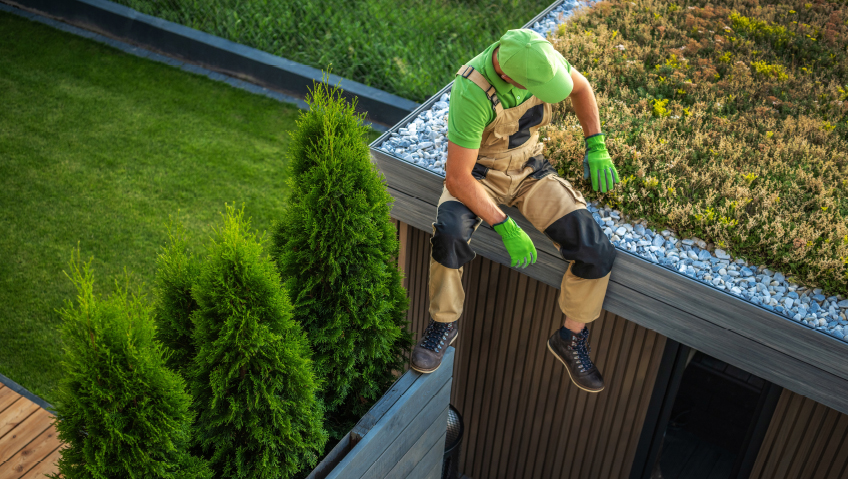
What’s old is also new again, and the U.S. federal government is now suggesting private incentives for the installation of green roofs in areas where the weather permits. Popular for their cooling effects through the transpiration action of plants, whereby water vapour is released into the air through the surface of each leaf, green roofs essentially provide natural air conditioning, relieving the need for electrically powered air conditioning by over 70 percent, according to a National Research Council of Canada study.
The consensus amongst leading urban designers across the globe, therefore, remains to focus on incorporating as many natural elements as possible to help cool cities down. Inspired by Middle Eastern wind towers, Madrid, Spain has built a spiral wind garden filled with ferns and moss. Based on the premise that the spiral draws cool breezes down from the treetops to reduce heat by four degrees Centigrade, the effect is so successful that hopes are that fewer Madrileños will escape to the seaside each August. Elsewhere, in Asia, sponge pavements, or pavements where water can permeate the surface thanks to natural infrastructure, prevent overheating through evaporation. Cities like Bangkok, Thailand and Athens, Greece are also turning forgotten plots of land into pocket parks to help improve temperatures.
Closer to home, cities are also working hard to plant trees and create green belts to ease the heat. According to Axios.com, Raleigh, North Carolina harnesses digital heat mapping software by Esri to guide its work on establishing greenery in areas needing temperature relief. These efforts are made possible by financial support from the National Oceanic and Atmospheric Administration (NOAA) and the Inflation Reduction Act. As it turns out, the city discovered that its least foliage-dense areas were also its historically underserved areas. Tackling this long-overdue task, citizens in low-income areas are now enjoying the fruits of recent investments.
Initiated in 2021, the Street Tree Equity Project endeavours to provide trees equally and equitably throughout the city. To date, two plantings since 2023 have seen 700 trees established in areas where they were lacking, with a third planting period kicking off in January last year. Now, the city even provides a map indicating the location of each new tree. In addition, following further investigation by Raleigh authorities into heat remedies, old-fashioned titanium dioxide, a reflective white, insoluble pigment used in sunscreens and as a colorant in paints, has been identified as the ideal material to apply to roads to remedy excessive heat in certain areas.
Work continues across the continent. While the United States Environmental Protection Agency published a notice in February this year advising that green infrastructure should be used to reduce power demands driven by cooling and heating devices, it also suggested collaborating with non-profits already established in the greening effort to enhance participation and drive canopy expansions in cities.
Perhaps one of the most exciting, fresh concepts, however, is that of peri-urban agriculture (PUA), a concept gleaned from time-series satellite observations over China. As arable farmland comes at quite a premium at best and is near impossible to obtain in densely populated urban areas at worst, a report published on nature.com notes that crops planted on the outskirts of smaller cities can potentially affect larger weather patterns. “By analyzing the interplay of biophysical factors, such as radiation, convection, and evapotranspiration, urban planners and policymakers can identify specific areas that require intervention through PUA management,” it states. Considering such an intervention, we may soon see the advent of the rural city of the future.
Ultimately, the effort to cool our cities will require a blend of innovation, policy, and a renewed respect for the role nature plays in the built environment. From reflective roofing materials and green infrastructure to equitable tree planting initiatives and peri-urban agriculture, communities across the globe are demonstrating that meaningful solutions already exist. As urban populations continue to grow and temperatures rise alongside them, the challenge now lies in scaling these strategies quickly and collaboratively to create healthier, more resilient cities for future generations.