The Canadian hospitality market is shifting, and with more Canadians travelling locally, hospitality leaders are turning to Chamberlain Group of Companies for a more strategic and integrated approach to delivering projects.
Offering design that protects budget and schedule from day one, Chamberlain Architectural Services combines with independent construction management leader Chamberlain Construction Services and its interior design division to deliver a fully integrated architecture, interiors, and construction solution. At home in Burlington, Ontario, the group has cultivated a highly coordinated approach over the years, providing project owners with greater clarity, control, and consistency when combining their services, while remaining committed to their respective independence and service transparency.
Together, the two young giants have forged impressive growth over the past 48 years. With numerous legacy clients and industry partners, some of the company’s relationships span decades, and with over 500 hotel design projects across Canada and the United States, the company has certainly earned its merit. The 30-year-old construction company has also built more than 150 hotels, while its decade-old design division has completed work on more than 100 hotels and hundreds of other hospitality projects, including work in Hawaii.
Chamberlain Group of companies is headed by a vibrant team of young yet seasoned changemakers. They are Architectural Principals Jon McGinn, Architect, NCARB, OAA; Linnea Chamberlain; and Steve Mauro, Architect, OAA. Chris Mauro is the Construction Principal, while Adrian Mauro serves as CEO of the Construction company, with Chris and Ersilio Serafini as Vice Presidents. Jackie Mauro serves as the Interior Design Director.
With a distinct presence in the Greater Toronto Area, the company continues cultivating its North American footprint. By giving clients the option of using one or both companies, its presence continues expanding—especially as customers who combine its services once rarely return to using only one of the firms. This option is especially popular with companies that work on strict budgets, as project integration affords greater fiscal control, especially when the entire team is engaged in projects early, allowing key decisions around cost, constructability, and design to be aligned from the outset.
There are many who hire only one firm or the other, however. “We’re trying to shed the label that we only do architecture work,” says Chris Mauro. “So now people are seeing that we are a full-fledged construction management company, and we do work with other architects.”
Its high level of expertise makes the company an outstanding choice for discerning developers in need of professionals who smoothly deliver practical, buildable solutions rather than theoretical design. By removing much of the noise common in design and construction processes, these experts take the weight of project management from clients’ shoulders, streamlining coordination and reducing risk throughout the process. Highly invested in the power of technology, Chamberlain balances hard-earned skill with modern placemaking, complete with interior design. It also allows attention to detail to set every aspect of its work apart, with everything from budgets to project specifications treated with the highest regard.
As all these attributes make Chamberlain the ideal partner for collaboration, the company is evolving from working on smaller, 100-room hotels to high-rise hotels and apartment developments. It has also entered the Toronto market in recent years with two large hotels and residential projects alongside purpose-built rentals currently underway in its downtown area. Staying well-informed on the latest market trends, Chris Mauro and his team recently attended a number of prestigious conferences focusing on property conversion and renovation in this field.
With a growing number of local and American hotel groups such as Marriott, Hilton, Hyatt, and others enquiring about property improvements on old hotels and motels that would secure high returns on investment, the next few years look good for business. The company is also working on a number of new hotel constructions in locations like Vancouver, British Columbia and Winnipeg, Manitoba, alongside hospitality conversions in Oakville, Hamilton, and Burlington, Ontario.
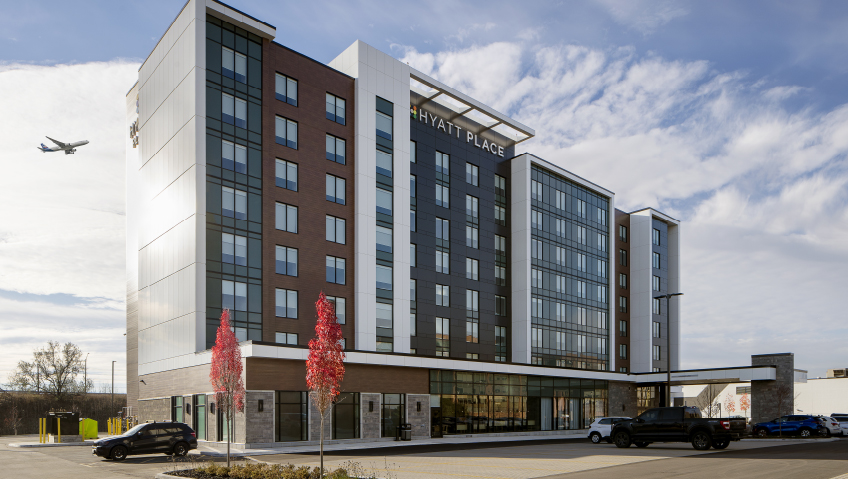
One current project that stands out is the brand new eight-storey Hyatt Place at Toronto Pearson International Airport. Responsible for all processes including architecture, construction, and interior design, this is the firm’s latest flagship example of its fully integrated project delivery in action. The 196-room hotel features an indoor heated pool, a fitness centre, dining, and multiple meeting spaces. The hotel is now known for modern interiors and an outstanding layout which includes a ballroom. This was an especially challenging project as it had to be concluded next to an existing hotel—a complex task by anybody’s standards, requiring careful coordination across design and construction teams.
Principal Jon McGinn ascribes the rise in hospitality construction to the market recovering from COVID-19 pressures and hospitality conversions outperforming the office market due to increased local travel as more Canadians choose to rediscover their own country rather than travel abroad. He also notes continued growth in the residential rental market. “I think we see hospitality playing a pretty big role in the next few years,” he says.
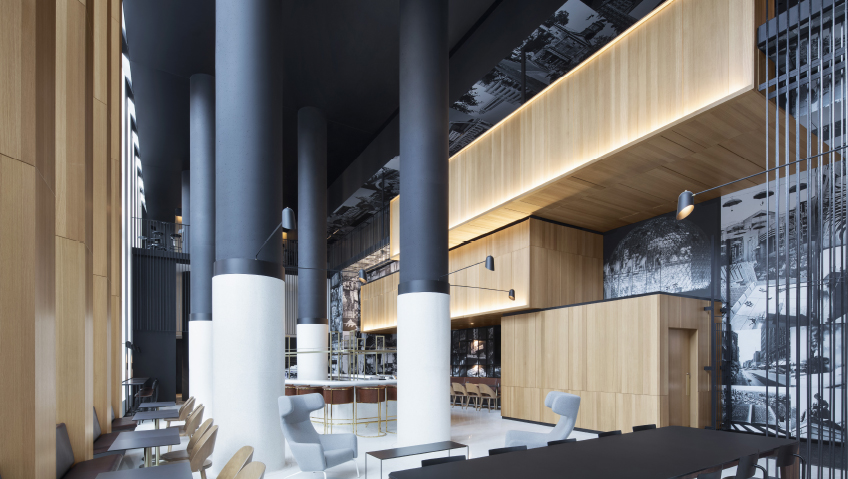
Approved as one of Marriott Hotel Group’s interior design teams of choice, Chamberlain’s prowess on this front is widely respected. Committed to a “construction-first” mindset, this team sets itself apart by being several steps ahead of design competitors who are typically purely aesthetics-driven. This advantage is achieved in the deep understanding of the architectural layers that comprise overall designs—an aspect of the process that very few interior designers truly grasp. By establishing a clear blueprint of not only electrical, plumbing, mechanical, and other systems, but also of who performs which roles, this team establishes a crystal-clear overview of the possibilities within the existing design, installation, construction, and engineering framework before setting off on decorating hauls. The result is a team of interior designers who are unusually technically and structurally minded.
While this system may seem immaterial to the uninitiated, the reality is that interior design done correctly is nowhere near as simple as it appears. By working in this way, the company saves project owners thousands of dollars and a lot of time, avoiding disasters. Another great plus is that its interior designers directly collaborate with its architectural designers, saving even more time, as working with external companies is typically far more time-consuming. That is because relationships and meeting schedules must be established from scratch.
“The architectural team is in the interior design firm as well,” says Jackie Mauro. “We’re all working together in the office, so that constant conversation is always happening. Sometimes we find we don’t even know where interior design ends and architecture begins because it’s so blended in terms of communication,” she says, pointing out that such close collaboration also improves project coordination.
Value engineering is thus a large and ongoing part of the company’s work. Chris Mauro, Jackie’s husband, typically gets involved in establishing design and construction budgets early in the process, keeping a tight lid on expenditures for the benefit of the customer, ensuring cost is managed proactively rather than reactively. “We have these conversations all the time about how it can be more effective and more beneficial for the client group, always,” Jackie adds.
Indeed, the company has a long history of good service. Established as Chamberlain Architect Services Limited by Brian Chamberlain in 1978, and joined by Adrian Mauro a short while later, the two leaders were inspired to improve upon the status quo of the time. And so, the partners set out to create a group of companies that would eliminate the petty and large frustrations common to the design and construction process, like trades clashes and schedule coordination, to name only two. Today, the industry has changed so little that their vision and what the firm delivers still outshine competitors—even when working independently with outside contractors.
To maintain these standards, technology investments are crucial, with Design Assist being one of the company’s most important tools. It offers sophisticated renderings that allow for clearer visualization and more confident decision-making, which truly help project owners in the decision-making process. The company also uses artificial intelligence to assist in some aspects of plan and code evaluation.
“We are testing different programs and different apps to see how we can run these plans through, what we can see. I think at this point we’re still seeing a lot of remedial information provided,” says McGinn, noting that the technology is in its very early stages. “It is nice as a second set of eyes, an opportunity to catch things,” he adds, underscoring the firm’s plans to further expand its investments in this technology over the next few years.
The company is also well-respected for its project documentation acumen. For this reason, it is often employed to complete this crucial process on behalf of other designers prior to construction. It also plays the role of third-party reviewer of completed architectural drawings, a process typically headed by Chris and Adrian Mauro.
Chamberlain’s team of around 50 is also known for its charity work, with 10 members partaking in the Princess Margaret Cancer Foundation Ride presented by Johnson & Johnson from June 13 – 14 of this year. Moreover, the firm has made contributions to the SPCA through a large animal hospital project it is working on for them in Hamilton. Then there is its work on a 56-unit affordable and accessible housing complex, complete with a 6,500-square-foot state-of-the-art training facility for the deaf and blind in Toronto. Spearheaded by the Canadian Helen Keller Centre, this project is at 150 Eighth Street in the Etobicoke-Lakeshore neighbourhood. “We were lucky to work on the architecture and interior sides. It’s a full modular building,” says McGinn.
With Chamberlain’s construction company’s sights set on expanding its portfolio of large, long-term projects, its design division is looking toward increasing its business in hospitality and lifestyle brand hotels for the boutique market. While the group continues finding ways of responding to geopolitical price issues in favour of project owners as much as possible, the company also continues refining and improving its offerings through investment and expanding its overall capabilities.
By continuously elevating the customer experience, these teams continue to do what they love best through superb architecture, construction, and interior design—building quality, long-lasting professional relationships across North America and the Pacific.