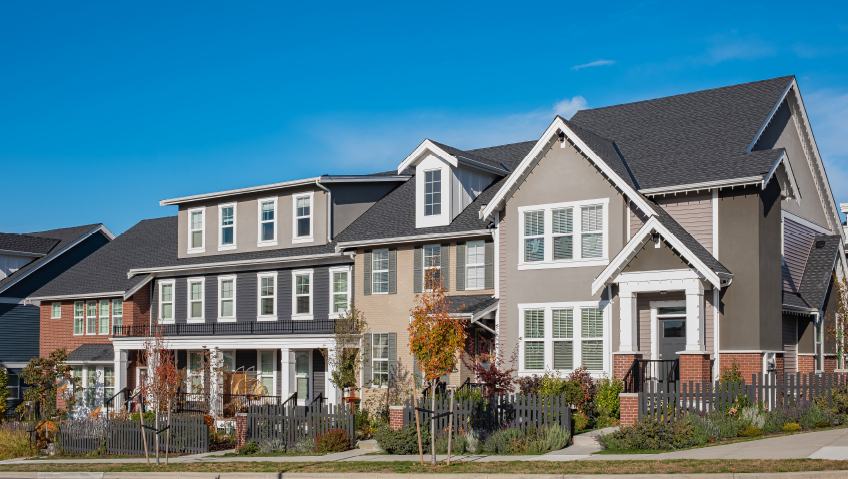
Contrary to common construction beliefs, it doesn’t have to be difficult, expensive, or time-consuming to build high-quality, energy-efficient structures. In fact, Enercept’s custom structural insulated panels (SIPs) simplify construction, streamlining the building process and creating affordability and energy savings.
Fabricated in its Watertown, South Dakota facility, Enercept’s SIPs are expertly designed to help save time, reduce energy expenses, and guarantee a long-lasting, worry-free structure that increases value over time due to superior insulation and factory-built accuracy.
Touted as a “smarter” method of building, SIPs are transforming the way buildings are formed, with Enercept leading the way, manufacturing custom SIPs that combine framing, insulation, and sheathing into a single high-performance panel. These SIP systems simplify construction, reduce energy costs, and provide unmatched strength and efficiency, making them the smart choice for residential, commercial, and agricultural builds.
Found in a wide variety of projects, including custom homes and cabins, multi-family housing, commercial and light industrial buildings, farm shops, barns, agricultural storage, offices, schools, and churches—and in many net-zero and LEED-certified buildings—SIP systems are fully customizable and engineered to meet code in all 50 states.
A composite building material made up of three key components—a solid EPS (Expanded Polystyrene) insulation core with two outer layers of 7/16” Oriented Strand Board (OSB) laminated together under factory-controlled conditions—these panels are used to construct walls, roofs, floors, and foundations, providing superior thermal performance and structural strength in one system.
Common “cold spots” or thermal bridging typical of conventional insulation are essentially eliminated by Enercept’s solid EPS core, with pre-assembled wall and roof panels manufactured in a climate-controlled facility and supplied straight to the construction site, resulting in a more efficient building procedure. Because SIPs are prefabricated, construction can proceed more quickly, lowering labor costs and shortening the project’s overall duration.
Additional benefits include every SIP being cut to exact specifications thanks to factory-built precision and an off-site construction method, which reduces job site errors. Better installation then results in a tighter, more energy-efficient envelope, which can save heating and cooling expenses by up to 60 percent, while framing time is also significantly shortened. In addition, combining more value with less waste means SIP homes are up to 2.5 times stronger than conventional wood-framed buildings.
Proudly building trust and accountability since 1981, Enercept celebrates its 45th anniversary this year as a pioneer in the production of its panels. “It’s been a fun ride,” says Neal Mack, Senior Regional Sales Manager, who has 30 years of experience at Enercept. Over that time he has seen a positive shift in acceptance of SIPs, as well as greater familiarity with them on both the builder and the consumer sides. “When I initially did trade shows back in the day, people would come up and say, ‘What is this?’ And now the reaction I get is, ‘Oh, my neighbor did this,’ or ‘Our church did this.’”
Although SIPs are definitely seen more often these days, many still consider them a newer technology, even though it’s been close to 100 years since the first one was used experimentally, Mack says. They have now been in regular use for the past 40 or 50 years for a variety of applications, but builders are still slow to change and acceptance takes time, he adds.
There are many different reasons why people use SIPs today, with the obvious one being their noted energy efficiency compared to conventional stud framing and fiberglass insulation, as well as their speed of assembly. “The length of time it takes to put them up is quite a bit quicker, being that the systems are built in our factory,” Mack says. “The changing of the building codes makes SIP panels more desirable as well, and that seems to be a driver for a lot of people in a lot of areas.”
With knowledge of these benefits, why is their use still not commonplace? Part of it is that SIPs tend to represent a bit of a paradigm shift for builders, Mack says, who typically have their tried-and-true system they use when they build. Moving to SIPs means adapting and changing, especially in terms of planning and working on approval drawings ahead of time.
“[With SIPs] they can’t work on the fly like they sometimes will,” he says. “There’s some planning that takes some time on the front end, but prior planning always prevents poor performance in the field. So that’s a change for builders that a lot of them have a challenge with, because it’s a little bit different than what they’re used to.”
It’s difficult to deny the ongoing and notable advantages of SIPs, however, particularly when it comes to green and sustainable building. The traditional method of wall framing is labor-intensive, often uneven, and prone to energy leaks, resulting in delays in development, bloated costs, and future increases in energy costs. Enercept’s wall panels are precisely designed and pre-assembled at its factory, with each panel having headers constructed, wiring chases built in, rough holes pre-cut, and high-performance EPS foam insulation sandwiched between oriented strand board (OSB), making it ready for on-site installation. This results in less waste, as precut parts reduce on-site mess and disposal expenses.
As for roofing, conventional stick-framed roofing systems can be difficult, time-consuming, and prone to irregularities and thermal gaps. Both during construction and over the building’s lifetime, poor insulation, age-related sagging, and labor-intensive assembly can cost extra money and time. Enercept roof panels are precisely pre-made SIPs that provide strength, insulation, and a smooth installation. By reducing thermal bridging and producing a strong, continuous insulating shell, these roof solutions keep extreme weather out and conditioned air inside. This produces an airtight, energy-efficient envelope that is quicker to build, more effective, and long-lasting, allowing for comfort and functionality in buildings that boast fewer air leaks, quieter interiors, and lower utility costs.
“For some people, that’s a real driver for them, but for some it’s not,” Mack says of the desire for sustainability and greener building within the industry. “We tend to try to assimilate to our clients’ needs and what they’re looking for. I’ve had some clients where energy efficiencies are sometimes not even in their top five [priorities]; rather, it’s the speed of assembly. Each of them has different reasons why they’re utilizing SIPs, and certainly, energy efficiency is one of them. Being green means using less dimensional lumber, and there’s a lot of that in what we do and what people want, but it really does vary for different clients.”
Of course, the versatility and customization of SIPs are also vital for each project Enercept undertakes, whether it’s the MLCV Urban Housing Project in downtown Minneapolis, Minnesota, the North House Folk School Welcome Center in Grand Marais, Minnesota, the Dakota Zoo SIP Penguin Exhibit, or a variety of affordable community SIP housing. Enercept’s work—and its unique SIPs—encompasses a wide range of structures for a variety of industries.
“There really isn’t anything that SIPS can’t be used for in either residential or commercial construction,” Mack says. “We can take conventional drawings and plans and convert them to an SIP and put it into our program to be panelized. We’ve done some really unique projects that we thought might have been beyond the realm of possibilities, but with computer programs, designs, and drawings that we can do, we’ve been able to push that envelope quite a long way.”
As a custom shop building to its customers’ wishes, Enercept’s challenges have included the volatility of the raw materials market over the last five years post-COVID—which seems to have subsided and is calmer now—but the company is currently facing potential movement in the oil market that could influence some of those material prices again—and already has, Mack tells us. “Taking that into account, we have great, trusted trade partners that we deal with that help us out as much as they can in providing materials to us,” he emphasizes. “We pride ourselves on not having allocations or having limited sources for materials.”
He notes that Enercept also continues to embrace a fully RTA (ready to assemble) system, which is one of the company’s biggest differentiators from others in the industry.
“We really pride ourselves on not having to do a lot of field manipulation of panels or field installation of materials,” he says. “We try to do as much of that in the plant as we can, as it’s more effective if we do it here in the plant as opposed to most of our contractors in the field. It just works so much better, and we try to accommodate that with them whenever possible.”
No company is successful without a team of skilled and trusted employees, and Enercept is no exception, with many celebrating numerous decades with the company, a testament to its superior company culture and one that Neal Mack himself can attest to.
“I think there’s some real positivity to that, and that comes from having solid ownership,” he says. “It’s a good and enjoyable place to work. I tell people I have a ‘get to’ job, not a ‘got to’ job. I get to do this, I don’t ‘got’ to do it, and I’ve thoroughly enjoyed it.”
That sentiment is one that seems to be shared widely throughout the Enercept corporation. “Some employees have been here 30-plus years, or even pushing 40 years,” Mack shares. “We’ve lost some good employees to retirement, but we’ve got a number of new, young, and aggressive ones now, which gives me hope for a future where we can continue to grow and expand our business and our market share going forward.”