Cushing Terrell is a multi-disciplinary design firm with 17 offices across the United States that unite to bring deep understanding and visionary perspective to the projects and the relationships it undertakes.
This has been the case since the firm’s founding in 1938 by architects who shared the belief that integrating architecture, engineering, and design result in deepened relationships and enhanced creativity, a defining characteristic that continues to inform projects and enables the firm to seamlessly captures its clients’ visions.
The client
Sometimes the best clients are secured through happenstance, and that is the kind of serendipity that brought Cushing Terrell together with Paul Starita, co-founder and CEO of The Flying Pickle, a man who has a deep-rooted passion for the sport of pickleball and an idea to bring it to Treasure Valley, Idaho.
“The project that we were doing was actually for an industrial project, dry storage, and as those types of spaces went down in popularity, the owner at the time opened it up to different types of facilities and looked at different options,” explains Project Manager, Josh Shiverick. This led to a match made in heaven.
Senior Interior Designer, Jill Lee, was brought onboard to work through the interior branding process with the client, a practice that achieved so much more than originally intended.
From Shiverick’s perspective, “With Jill’s involvement, her ideas, she was really able to take Paul’s thoughts and turn them into physical objects and really created such a strong relationship and a dream come true for Paul.”
While the project was a dream come true for the client, Starita, too, was a “dream client,” who put a lot of value on wanting to develop his brand and the experience it would create for his members. Lee says, “He really valued interior design and experiential design and branding. He understood that creating something fresh and new takes time and a lot of research and creativity and care in how we would execute his goals.”
The vision
The team at Cushing Terrell took what was simply a space and created a visionary branded interior that would become trademark of The Flying Pickle as its franchises continue to take off and span the United States. The client had a clear vision, but Cushing Terrell took it far beyond what anyone could have imagined. Harnessing the passion Starita brought to the sport and the project, the team got to work.
The Flying Pickle evolved from an idea to reality through consultation, research, and a cohesive understanding that this project was to be so much more than courts to play on: it was going to be the core of a community of players of all skill levels who unite through sport.
“There are a lot of reasons why pickleball appeals to so many different types of people for different reasons and it’s just very universal, so thinking about it in that way and thinking about how exciting it is for pickleball lovers and professionals alike, it just makes us want to do a really great job for them to create spaces that they’re going to want to keep coming back to,” says Lee of the project.
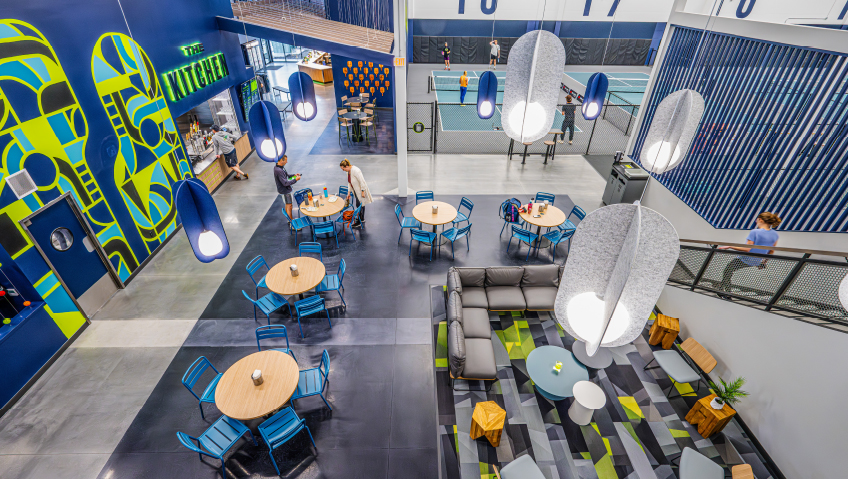
When you walk through doors of The Flying Pickle, this sense of community is clear thanks to the distinct character of the space. Thoughtful design, careful material selection, and the integration of local artists all elevate the brand with local flair, and locations are curated through extensive consultation and research—which included a deep dive into the sport of pickleball.
The execution
“We have a pretty thorough design process here at Cushing Terrell and it starts and ends with research,” explains Lee, who highlights that through visioning sessions, the team gets to the very bottom of the vision by asking questions, listening intently, and understanding the desired outcome. We curate these very specific workshops where we ask a lot of questions, we dig into what the goals are from the client’s point of view,” she explains.
“That required us to do a lot of research into pickleball itself and what the origins of pickleball are—who invented it, why was it invented, where was it invented—and all of that became the foundation for our design concept for the space.”
Through these activities, Cushing Terrell discovered that pickleball was founded many decades ago by a multi-generational family in their backyard in a suburb of Seattle. It has grown in popularity throughout the years, recognized not only for the sport itself, but for the community it affords.
The interior design of the flagship location drew inspiration from the original wood paddle and the flora of the Puget Sound where the sport originated when it came to material, texture, and color selections. For Lee, “Those are all parts of the elements that we used to create a design for the space, from color and texture to the zones and all the different areas for members. When they’re not enjoying the game of pickleball, they are enjoying spaces that promote community and family and belonging and coming together in different ways.”
The front of the 49,000-square-foot building features a pro shop, restaurant, and lounge, as well as locker and shower facilities, and a flex room that can be rented for private events and pop-ups. Through the doors, players will find 17 courts that have been designed for every skill level to enjoy.
The outcome
The Flying Pickle is the first of its kind in the Treasure Valley. Prior to its establishment, lovers of the sport were relegated to playing anywhere they could, which didn’t lend to the sense of community the sport thrives on.
Architect Tina Rothermund notes, “It really is a place where the community comes together, which is unique, and I think pickleball lends itself to that. They’ve placed such an emphasis on [being a place for community] from a design perspective.”
Cushing Terrell worked with the ownership group, including professional pickleballers, to ensure that the facility performed to the highest caliber for its members, which meant testing out materials and coatings to ensure that the cushion and grip was optimal for performance.
“One of the owners is a world champion, and she definitely knows the game of pickleball and what to expect, so it was good to get input on that side. It definitely performs at a high level,” says Shiverick.
What started as one high-performance facility has led to a relationship that spans the United States. To be able to replicate the brand across locations and geographies, which introduced its own challenges given the unique facility spaces, building codes, and environmental factors of the various locales, Cushing Terrell created a Design Criteria Book that includes hundreds of pages of standard design features to be included, ensuring seamless design across locations and franchises.
The team continued to iterate these documents with lessons learned or to make improvements to ensure the design value remains consistent as well as competitively priced, given the different construction costs, budgets, labor availability, and conditions of the space being designed. For instance, the costs of construction in Meridian, Idaho will differ greatly from other states, but there is still the opportunity to maintain consistency in the design, shape, and layout of the spaces.
Discussing the ease of design of the original location, Lee notes, “The building architecture lent itself to co-locating all the member amenities and support spaces at the front when you first enter and then it opens up to this large playing area that has all the courts, and you can see the vista all the way through the building,” from both the floor and the mezzanine.
From Shiverick’s perspective, “The initial location in Meridian was just a perfect fit. Column spacing was perfect and fit the exact size of the number of courts, and it really was like it was made specifically for pickleball. It’s pretty interesting how that worked out.”
This has not been the case with later projects. “I don’t think that we have a single building yet that’s like the original one. We’re having to look at applying that same strategy to buildings that are just different,” says Lee. “We have to creatively apply our strategy that worked so well in the first one to new locations and building types around the country.”
From pre-engineered spaces to vacated retail facilities, as long as the column spacing and floor heights are suitable and dimensions are ideal, every project is workable. “There’s a certain dimension that we need in order to support good play of pickleball and professional play of pickleball,” explains Lee, which includes considerations for everything from layout and building materials to lighting and everything in between.
As The Flying Pickle projects take the firm across the country, Cushing Terrell is also being exposed to new technologies, vendors that may offer improved surface conditions, or cushion, barriers, and other components that improve the quality of the courts and thus the quality of play.
A culture of community
Through its work, Cushing Terrell not only creates spaces that meet the needs of its clients, but also relationships that carry them forward. The concept of success goes far beyond project completion.
For The Flying Pickle, a successful outcome would not have been possible without Cushing Terrell, a firm that can harness a client’s vision and energy only because internally it shares that same sense of community, passion, and pride for the work it does and the people it serves through the built environments it creates.
Now working on a soccer stadium in Treasure Valley, the team has learned a lot about not only designing branded spaces but creating places for those communities to call home, in doing so becoming a true force in the sports and recreation space.