For ACDF Architecture, growth is not defined by scale alone; it is measured through precision and the ability to deliver architecture that responds intelligently to both constraints and opportunity.
Since its founding in 2006, the Montreal-based firm has evolved into a practice of approximately 100 professionals, delivering projects that range from residential developments to complex infrastructure. At its core is Co-Founder and President, Maxime Frappier, whose perspective reflects a balance between creative ambition and technical rigor. “We started our career in 2006,” Frappier says. “It all started with these two guys and now we have three partners and run an office of about 100 people.”
ACDF’s early years were defined by projects that demanded more than aesthetic vision. The company began by working with religious communities across Quebec, designing long-term care and residential facilities. These clients, Frappier explains, played a critical role in shaping the firm’s approach. “They were the perfect clients,” he says. “They were asking us to work with precision and diligence, so we had to learn how to be very precise yet creative as well.”
Working within heritage contexts and highly structured decision-making environments required a level of clarity that continues to inform ACDF’s process. Every design decision had to be justified, not only creatively, but financially and functionally. “We learned to design while making sure to use the proper amount of resources to achieve our goals,” Frappier says.
This early experience instilled a mindset that remains evident in the company’s work today. Rather than pursuing architecture as a purely expressive discipline, ACDF approaches it as a careful negotiation between intent and execution.
As the firm expanded into institutional and cultural work, including libraries and aquatic centres, it continued to refine this approach. Budget limitations were not treated as obstacles, but as design parameters that could drive innovation. A defining example is a cultural centre project where the team pursued stainless steel cladding, an ambitious material choice within a constrained budget. To make it viable, ACDF re-evaluated the entire program.
The process extended into technical execution. By aligning panel dimensions with manufacturing standards, the company minimized material waste and avoided unnecessary costs. “If you don’t want to have any loss, try to make sure that you play with these modules,” Frappier suggests.
This level of coordination between design and construction is a recurring theme in ACDF’s work, reflecting an understanding that architecture is created through collaboration between engineers, fabricators, and builders. “All of that pragmatism was always embedded in our process,” Frappier says.
As ACDF’s reputation grew, it began working more closely with private developers, particularly in the residential sector. These projects presented a new challenge: delivering distinctive architecture within tight financial frameworks. “We were able to create something unique with the same amount of money,” Frappier explains, and this ability to elevate standard building typologies without exceeding budgets has become a key differentiator for the firm. By applying the same principles of prioritization and efficiency, ACDF demonstrates that design quality does not have to be sacrificed in cost-driven environments.
The company’s work in this sector also reflects a broader shift in the construction industry, whereby developers increasingly seek architects who can balance creativity with practicality.
While establishing itself locally, ACDF has also actively pursued international opportunities. Early projects in the Middle East and Asia provided exposure to large-scale developments and diverse construction contexts. A pivotal moment came when the firm was shortlisted for a major waterfront project in Taiwan, competing against globally recognized practices. Although the project was not secured, the experience reinforced ACDF’s confidence and clarified its design philosophy: rather than adopting highly expressive or symbolic forms, the team chose to focus on balance. “We were rejecting things that were just a little bit too extravagant. We were trying to find the proper balance between the efficiency and the aesthetics.”
This philosophy proved instrumental when ACDF was invited to redesign a major development in Vancouver under an aggressive timeline. The successful delivery of that project led to further opportunities across Canada and internationally, establishing ACDF as a firm capable of operating at multiple scales.
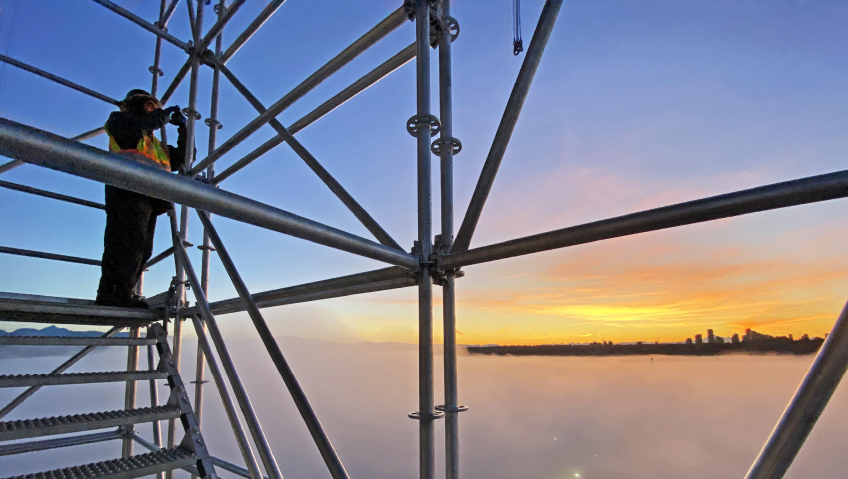
Today, ACDF’s portfolio includes projects that extend far beyond traditional architecture. Among the most significant is its role in the redevelopment of Montreal’s Olympic Stadium roof, a project that demands coordination across a large network of specialists. “It will probably be the most complex project that is getting built at the moment in Montreal,” Frappier says.
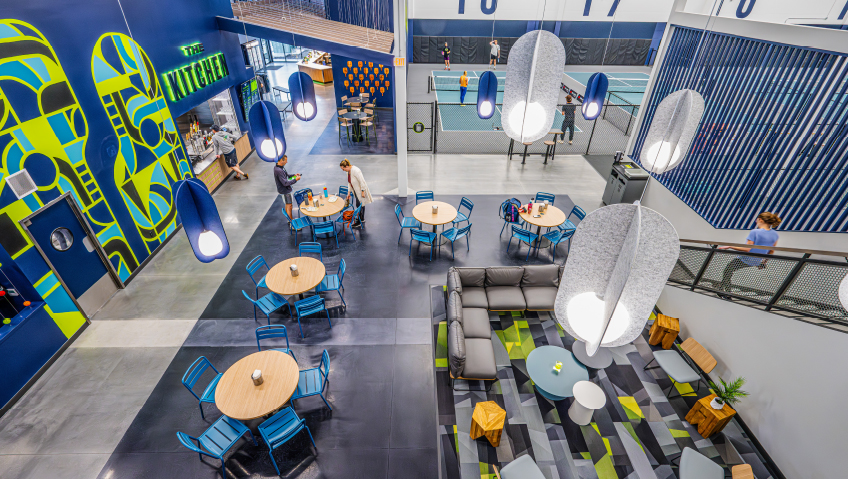
Indeed, ACDF is a multidisciplinary team with the ability to operate within highly technical and demanding construction environments. “A creative architect can also lead an enormous team in technical and very highly complex projects,” says Frappier. Additional projects reinforce this approach, including a new subway station in Montreal, a prefabricated high-rise in Toronto, and residential developments in British Columbia, each highlighting the firm’s capacity to integrate design thinking into complex construction processes.
Of course, Frappier’s perspective on architecture is closely tied to the Canadian context. He describes the country’s design identity as one shaped by climate and resource constraints. Canada’s extreme temperature range requires significant investment in building performance, particularly in envelope systems, and as a result, architects must make careful decisions about where and how resources are allocated.
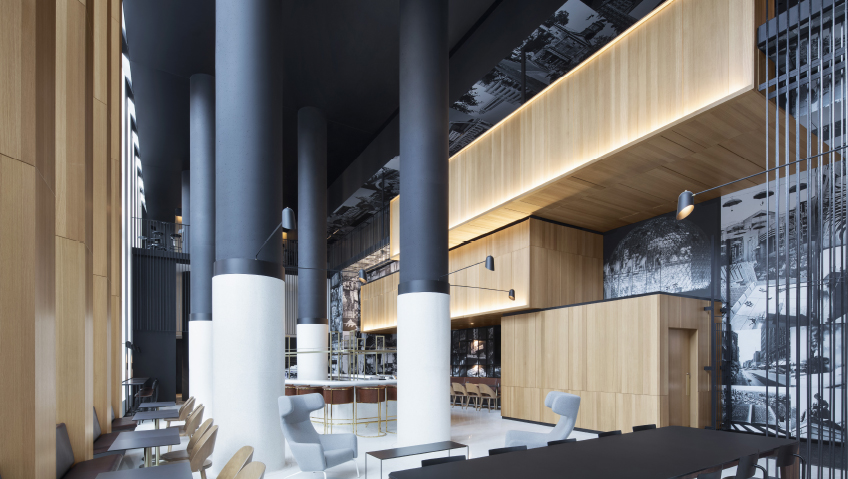
At the same time, Canadian architecture reflects a cultural duality that blends North American efficiency with European sensibility. This combination, Frappier believes, creates a unique design language. “We have the North American pragmatic approach, but we have the European taste for aesthetic,” he says. Rather than relying on spectacle, ACDF emphasizes clarity and restraint, and its design strategies often focus on contrast and material relationships to create visual impact.
Frappier’s involvement with the Royal Architectural Institute of Canada has played a significant role in shaping his career. Receiving the Young Architect Award in 2013 marked a turning point, providing exposure to a broader professional network. “I was really amazed to meet so many architects,” he says. “I started to believe in the capacity that we had.”
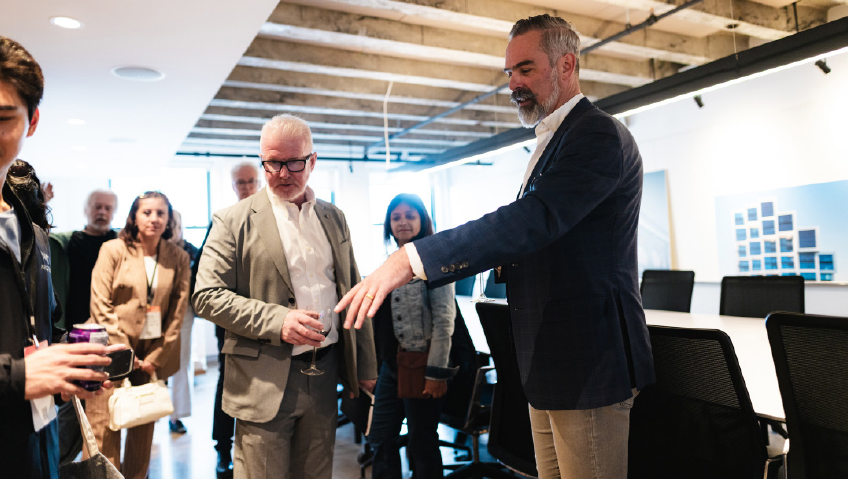
Through RAIC events and collaborations, Frappier built relationships that later contributed to major project opportunities. He emphasizes the importance of community within the profession. “You need to be part of something,” he says. “We are all part of a community.” This perspective informs ACDF’s approach to collaboration, both internally and externally.
Within the firm, leadership is structured to encourage engagement and continuity. In addition to its three partners, ACDF includes a strong network of associates who participate in the firm’s success, a model that fosters a sense of ownership and supports long-term growth. As the company looks ahead, it is actively preparing for future transitions by integrating new leadership. Frappier describes his leadership philosophy as one rooted in alignment and collaboration. “Good leadership creates harmony,” he shares.
Now, the rise of artificial intelligence (AI) presents both opportunities and challenges for the architecture and construction sectors. Frappier approaches the topic with measured optimism. “I’m worried, but I’m excited as well,” he says.
He sees potential for AI to streamline repetitive tasks, allowing architects to focus more on design and problem-solving. However, he also cautions against overreliance on automated processes. “[Architecture is] an art of composition,” he says. “Not an art of assembly.” For ACDF, the priority is maintaining the integrity of architectural thinking while leveraging technology to improve efficiency.
As ACDF enters its third decade, its trajectory reflects a commitment to both growth and responsibility. The firm continues to expand its portfolio while remaining grounded in the principles that defined its early years. “I’m still drawing all day long,” Frappier says. “I’m still an architect.”
That perspective underscores a broader ambition: to demonstrate that creative architects can operate successfully at every scale of the built environment. “If you are not able to generate the next generation,” he says, “the profession is going to die.”
For ACDF, the future of architecture lies in balance—between creativity and pragmatism, ambition and discipline, innovation and responsibility. It is an approach that not only defines the firm’s work but also contributes to a broader understanding of what Canadian architecture can achieve in an increasingly complex world.