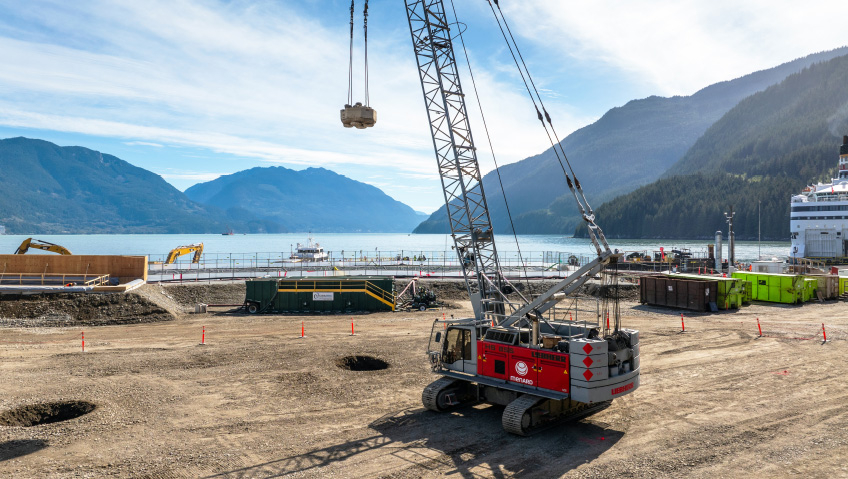
Known today as part of the western arm of a larger global construction company, Menard Canada is truly homegrown. The business behind Menard Canada, originally known as Geopac, was founded in 1971 in Montreal and operated as such for over 50 years, serving as a ground improvement specialist contractor. In 2007, Geopac was purchased by the Menard group, a worldwide geotechnical conglomerate based in Paris, France, and is now part of a larger scope of solutions for ground and soil improvement across the country.
David Huggins, head of National Pre-Construction Business Development, initially worked with the company as a consultant. In 2020, he transitioned from an entrepreneurial consulting role to fully joining Menard, seeing it through the current decade. He describes Menard’s role on a given construction project as one that “has everything to do with the soil.”
No matter the type of stakeholder—developer, geotechnical or structural engineer, or general contractor—when one is trying to purchase or build on a site with a challenging soil situation, Menard is called on to look into the difficulties the soils present and the capacities needed for it to support a structure, using design-build solutions as part of its detailed approach to ground improvement. The formula is essentially such that, if a structure is under 20 storeys and has deep compressible soils from two metres and deeper, Menard can deliver strong value.
This decade, so far, has seen Menard Canada capitalize on its momentum. Huggins says that, from the waning days of the COVID-19 pandemic up to 2024, the industrial sector was quite active, with the company completing numerous projects. Now, the market has paused, leading to a switch toward project in transit and infrastructure. Recently, Menard worked on a project for a maintenance facility for the under-construction Ontario Line in Toronto, part of the province’s new transit expansion. The team has also been involved in mining—specifically, support for a tailings dam project in northern Ontario.
Menard typically does not deal in high-rise developmental work simply because its systems are not built for those kinds of projects. Instead, it has been able to capture the market in mid-rise developments as well as communities dealing with old fill sites and deep, soft soil that needs to be strengthened before building new structures. Affordable housing has also been a hotter market for Menard, with a 15-person team undertaking a series of projects for Habitat for Humanity in the Greater Toronto Area (GTA).
During the early 2020s, the warehouse market was a big driver of the company’s revenue; however, the market for building industrial warehouses to specification is not as vigorous now. Huggins says that this is due to ongoing political uncertainty, as well as a scramble throughout COVID to establish last-mile setups for warehouses. Now, one of the more dynamic segments surrounds the boom in AI data centres, one of which Menard worked for in 2025. There has also been a push toward building public spaces such as community centres and hockey arenas.
The diversity of sectors in which Menard excels demonstrates its flexibility in applying its ground improvement systems and solutions. The beauty of the business is that it operates in a sector-agnostic fashion, says Huggins. This means that the type of structure does not matter, whether hospital, warehouse, data centre, or mid-rise building; if the soils are not good and a customer wants to avoid either a costly deep foundation system or a large replacement program, Menard has the answer. “We can be across all different sectors because we deal in the dirt,” he says.
Thanks to the breadth of work that can be found across different market segments, Menard has grown and opened new offices across Canada in the last five years. Since the company operates in a decentralized manner, with each office essentially operating its own business unit, it has been able to expand its teams and provide opportunities for its staff. “In an economically uncertain environment, people are looking for value,” says Huggins, and if people are motivated to build but are in need of cost-effective foundation solutions, Menard exists in that sweet spot.
As agile as the company has been inside the construction space, its role is still not as well-known as one may think. When compared to larger earthworks programs or piling/deep foundation systems, the area of ground improvement is still relatively new in terms of knowledge base and acceptance within the design community. To counter this, the company has been hosting lunch-and-learn talks with geotechnical engineers to get the word out about ground improvement. These talks cover topics such as excess soils, structural design codes, and why ground improvement makes sense on construction sites.
While keeping eyes open with respect to the rest of the year, Menard Canada will be taking a more cautious approach to operations. The business has grown substantially over the past five years, with things stabilizing in 2025, and this has allowed operations to catch up and ensure that the company is able to complete its volume of work under the right corporate structure. As Prime Minister Mark Carney announces major infrastructure projects, the company has been keeping active in areas like long-term care and getting good repeat business out of it, a trend it hopes to extend. It is also keeping its eye on transit expansion, especially in the GTA, with new highways, embankments, and associated works being built.
Menard is also monitoring housing projects closely, as many investment decisions are currently on pause. Developers are waiting for decisions on additional federal support—particularly the removal of certain charges and fees—to help improve project viability. While Menard is typically involved early in the construction process to offer ideas and solutions, investment in these capital-intensive developments has slowed over the past 18 months and as a result, some projects have been delayed or pushed into uncertain timelines.
In response to these market conditions, many developers are shifting away from high-rise condominiums toward larger, lower-density housing formats—a trend that aligns with Menard’s vision.
“We pride ourselves on our safety record and our approach to risk management,” Huggins says. Being owned by a large, publicly-traded European conglomerate, Menard Canada has both a great depth of resources and the nimbleness of local offices, teams, and yards. This results in a best-of-both-worlds situation for the company in delivering tailored solutions to its clients, as each project brings its own constraints that determine the best course of action. Menard Canada is more than ready to go from a project’s secret weapon to being an irreplaceable part of the construction process.