When Sean McDonald describes Erland Construction, the company his grandfather, an Air Force veteran, and his father helped build, and which he now leads as President, the language he reaches for is not about square footage or contract values. It is about foxholes.
“You could go to another company and work on a similar project with a different logo on your shirt,” McDonald says. “What makes the experience different is the people. When you have a team that shares common values, supports one another, and embraces a true foxhole mentality—where everyone is committed to each other’s success—it creates a culture that’s difficult to replicate.”
That philosophy, rooted in accountability and a quietly fierce loyalty to culture, has defined Erland’s nearly five-decade journey from a five-person open-shop spinoff in Burlington, Massachusetts, to a multi-division construction firm with a portfolio spanning student housing, life sciences, and academic institutions across New England.
Erland Construction was established in 1977 as the open-shop arm of a leading union contractor, created to deliver more cost-effective construction, particularly for Nordblom Company in Northwest Park, where Erland’s offices remain to this day. When legislation prohibiting so-called double-breasting (the simultaneous ownership of both union and open shop companies) came into effect, Erland broke away as an independent entity with just five employees.
The company took its name from its founding president, Kenneth Erland Froeberg, whose story was cut short when he passed from a heart attack in 1983. At that point, Tom Blesso and Chuck Vaciliou, both still with the company today as Board Members, faced a pivotal decision. Young, capable, and clear-eyed about what they didn’t yet know, they sought additional leadership rather than overreach.
They found it in McDonald’s grandfather, Bob McDonald, whose own story is one of improbable ascent. Growing up in Jamaica Plain, when he was 10 years old he lost his father, so he and his brother caddied after school to help their mother cover rent. In 1949, he was in the first class of Francis Ouimet Scholars, an award that paid full college tuition and enabled him to go to MIT and Harvard. Upon graduation he went to Vappi Construction for 27 years followed by a stint at Gilbane, before he joined Erland as President. “He grew up with a lot against him,” McDonald says, “but through that scholarship, he was able to accomplish things that would have seemed very unlikely given the environment he was raised in.”
Steve McDonald, Sean’s father, joined the firm in 1986 and later became President in 1997. The triumvirate of Steve McDonald, Tom Blesso, and Chuck Vaciliou each brought complementary strengths that have carried the company through decades of growth.
Sean himself worked as a laborer during summers while in high school and college, and eventually joined as an Assistant Project Manager in 2017, also serving as a Project Manager, Estimator, and Vice President throughout his tenure. He stepped into the presidential role around a year and a half ago. “I grew up around the business,” he says. “Coming to kids’ holiday parties at five years old and going to the Erland family cookouts. What always stood out was that our people never approached it just as work. They took pride in what they built, held themselves accountable, and genuinely cared about each other and the company’s success.”
Today, Erland operates in several markets. Its Residential division focuses on heads-in-beds projects, apartments, student housing, senior living, and hotels. Its Advanced Tech/Life Sciences group handles technically complex environments, including cleanrooms, laboratories, and increasingly, client-driven expansions into office renovations and institutional upgrades. The third arm, ACC, Academic, Corporate, and Commercial, covers the broadest range of work, with academic construction currently representing one of the firm’s strongest performing sectors.
In 2022, the company reached a peak of $320 million in volume, a high-water mark that was followed by what McDonald describes candidly as turbulence—a convergence of market headwinds, high interest rates, material cost escalation, and the significant internal transition involved in implementing an Employee Stock Ownership Plan (ESOP).
“It takes discipline to remain focused on the opportunities that align best with your team’s expertise and capacity,” McDonald says. “Our goal is always to ensure we have the right people and resources in place to deliver exceptional results for our clients while creating a positive experience for all team members. When those elements come together, it sets the foundation for a successful project for everyone involved.”
The ESOP transition, which Erland completed in 2022 and announced in 2023, was deliberately structured to preserve independence rather than enable exit. Leadership made the decision to sell a portion of the company to its employees, giving them a direct financial stake in Erland’s future.
For McDonald, the ESOP formalized something he had observed since childhood: that Erland’s people had always behaved like owners. Average tenure at the company currently sits at 12 to 13 years, a striking figure given that the majority of its staff are under 40 years of age. “Employee ownership reinforces that commitment by creating meaningful opportunities for long-term wealth creation and career growth,” he says. “The goal was: how can we make Erland an enduring organization for generations to come?”
The ESOP also functions as a retention and recruitment tool at a moment when the construction industry more broadly is seeing average tenures shrink to two or three years. Erland’s workforce includes four members of the Driscoll family, three McDonalds, three Crafts, three Burkes, and multiple second-generation employees who grew up knowing the company before they ever worked for it.
Perhaps the most visible expression of Erland’s current capabilities is a $130 million student residence project underway for Capstone Development Partners at Tufts University in Medford, a two-tower, 10-story development delivering 664 beds to a campus operating in one of the country’s most acute student housing markets. “The greater Boston area has been under a severe housing crisis,” McDonald notes. “Having the privilege to help shape the student residential experience on such an important campus is something our team takes a lot of pride in.”
The project was procured as a design-build undertaking in partnership with Capstone Development Partners, an Alabama-based developer whom Erland had previously engaged on a potential student housing project at Clark University in Worcester, a project that ultimately was canceled due to FAFSA-related complications. Despite that early setback, a strong partnership was developed between Erland and Capstone.
The Tufts project marks Erland’s second use of Canam Hambro’s composite floor system, a prefabricated solution involving composite steel joists capable of spanning up to 43 feet, with larger web openings for routing of services. The system allows 3.5 inches of concrete to be poured over wire mesh and plywood, with the plywood stripped from beneath within 24 hours. The key advantage over traditional stick-frame construction is that the floor below can be worked on concurrently, accelerating the overall program.
The project is also Erland’s first to be built under Massachusetts’ passive house energy code requirements, an increasingly prominent feature of the state’s construction landscape.
“Complex projects inevitably present challenges, but they can be successfully managed when the entire team is aligned around a common goal,” McDonald says. “That collaborative approach has allowed us to maintain our schedule and budget objectives while continuing to meet our client’s expectations.”
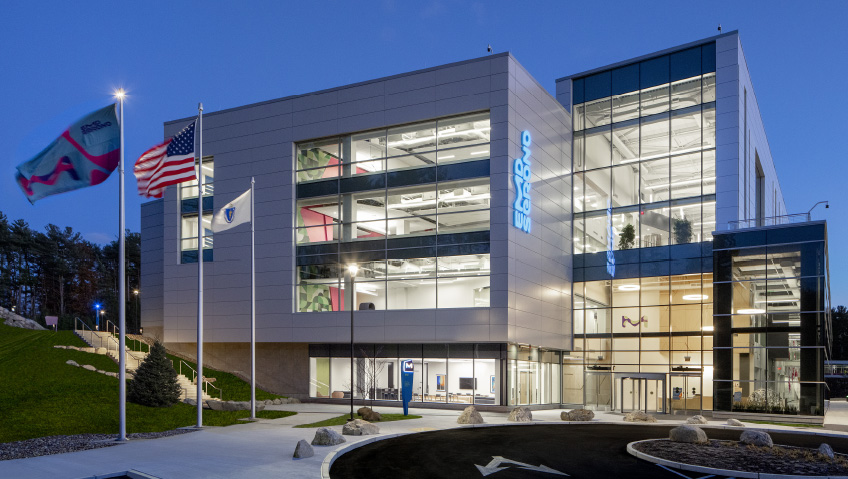
Erland’s Advanced Tech/Life Sciences division has built its reputation through sustained positive client relationships that generate ongoing campus-wide work. EMD Serono’s Billerica facility is focused on difficult-to-treat conditions like infertility, multiple sclerosis, and cancer research, and has been an Erland client since approximately 2018, with ongoing projects as their program expands.
Vice President and Director of Operations, Matthew Combs, who oversees the division as a partner in the business, was the original project manager on the account, and McDonald tells a story that captures what long-term partnership in life sciences construction can mean in practice: a medication developed in the facility Erland built was later used to treat a member of Combs’ own family. “It’s pretty meaningful when you see that you’re not just building a project, but something that has a real impact on the community and people around it,” McDonald says.
In the independent school market, Erland is currently delivering a field house at Middlesex School in Concord, emblematic of the academic sector relationships which McDonald says are built on trust and transparency.
This kind of investment in the community also underpins the Erland Foundation, now in its tenth year of service under the leadership of Steve Craft, Chris Landry, Nicole Harrison, Chris McHugh, Melissa Craft, and Bernadette Flaherty. The Foundation has evolved from a charitable giving vehicle into a broader platform for employee volunteerism and community engagement, and has exceeded $300,000 in fundraising in the past decade, a milestone the company marks with visible pride.
A longstanding partnership with the New England Center for Children (NECC) sits at the heart of the foundation’s work. Erland’s eighth annual Strikeout Autism bowling event brought together NECC staff, students, families, employees, and trade partners in February. And more recently, Erland staff participated in NECC’s annual 5K, giving up personal weekend time to support the center’s work.
The foundation also supports housing organizations, youth membership programs, food security initiatives, educational nonprofits, and healthcare causes across Greater Boston.
Never one to stand still or lag behind, Erland’s approach to artificial intelligence mirrors its broader philosophy: measured, purpose-led, and resistant to trend-chasing. The company currently uses Voyage Control for material tracking on the Tufts site, Briq for financial automation, and Billy for insurance compliance monitoring.
“We’re not always the early adopter of whatever’s hot in the market,” McDonald says. “We’re looking for the right thing that’s going to address the issues we’re actually trying to solve.”
This caution is grounded in experience. On takeoff tools, Erland found that the time saved by automation was largely consumed by the verification process required to catch errors—missing windows on an elevation, for instance. The tools are evolving, McDonald acknowledges, but have not yet reached the point where they can be trusted without the kind of scrutiny that negates the efficiency gain.
Erland participates in a peer group of non-competing firms from across the country, meeting twice yearly to share Best Practices and intelligence on technology adoption, AI in particular. “We want to find the right things that actually improve efficiency and provide value to our clients and our team,” McDonald says. “We also focus on AI policy, making sure people are using it responsibly and that we’re protecting not just our own information but our clients’ information.”
At the heart of Erland’s next chapter is a recently revised set of core values operating under the banner of “O.W.N. It,” which stands for One Team, Winning Results, and No Excuses. McDonald is candid about the tendency of company values to exist only on websites and in welcome packs, and Erland makes it a point to do things differently.
In the past year, the company has sent 20 percent of its employees to Team Trek. This week-long program in Arkansas is centered on personal and professional development and leadership self-awareness. It is this kind of investment in people that McDonald believes will contribute to Erland’s competitive position going forward as much as any technology platform.
“If we continue to invest in our people and do everything we can—with more of a servant leadership approach than a shape-up-or-ship-out attitude—we’re going to be more successful,” he says. “Construction is still, at its core, a people-driven industry. Pick up the phone, go to the job site, be a person. The human connection is so important.”
For a company approaching its 50th year, still headquartered in the same Northwest Park where it first broke ground, that is not nostalgia; it is strategy. And it is a winning formula that will surely stand this firm in good stead for another 50 years.