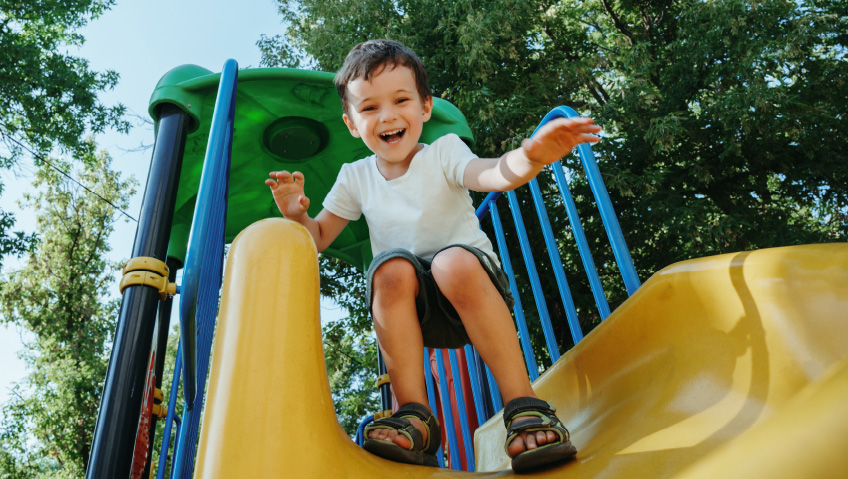
It is said that play is the work of the child, and so it must be that playgrounds and parks are some of the foremost places where this critical work can take place, particularly when safety, accessibility, and inclusion are designed into the built environment.
For good reason, play is even protected as a fundamental right in Article 31 of the United Nations Convention on the Rights of the Child, deep recognition of the benefits of play and the importance of its role in development. Play is paramount to cognitive, physical, emotional, and social development, which makes it good for the mind, body, and soul. It is where imagination comes to life, where challenges and fears are faced, and where relationships with others and the environment are navigated.
While play can happen almost anywhere, one of the most accessible locations for play is found in public parks and playgrounds where children can congregate and be free to explore and where the imagination can run wild. From spaceships and pirate ships to castles in faraway lands, a playground can become whatever a child’s mind can muster. It is a blank canvas where children can be anything, or anyone, they want to be, particularly when the equipment and the space have been optimized for use and safety.
Fun for all ages and abilities
Any discussion about safe and inclusive spaces must begin with universal design (UD), a principled approach to creating spaces, places, and products that support access, safety, and inclusion in the built environment, enabling use by all people regardless of age or ability. Where UD is applied, there is no need to require special adaptations as they are already considered and incorporated into the design proactively and thoughtfully.
Established by architect Ronald Mace at North Carolina State University, UD is built upon seven principles including equitable use, flexibility in use, simple and intuitive use, perceptible information, tolerance for error, low physical effort, and size and space for approach/use.
Whether it is the inclusion of automated sliding doors, the use of symbols and language, tactile flooring, lever-style doors or handles, or ensuring that spaces are barrier-free and have room to manoeuvre, UD is the consideration of the component parts of a space that contribute to the functioning of the whole. For instance, an inclusive park is one that seeks to remove physical and social barriers to interaction and enjoyment of the equipment and lands, or the inclusion of sensory zones and quiet areas, and so much more. From the design to the materials, like swings with harness supports and wheelchair-accessible structures with double-wide ramps, these spaces are designed for use by all.
The importance of play
Play stimulates brain development which supports cognitive function including the ability to think critically, solve problems, navigate challenges, and build confidence in one’s fine and gross motor skills and abilities, as well as social skills. Whether engaging individually or as a part of a collective, public recreational spaces offer countless opportunities for social interaction where children (and adults) can cooperate, empathize, share, and navigate disputes.
Children especially benefit from unstructured play time, which supports the development of their independence, confidence, and ability to navigate their own feelings of physical and emotional safety. And while this is true of children, adults also stand to benefit from time spent in play in parks and public spaces, as it serves to support cognitive growth and memory, physical wellbeing, and emotional and social faculties at all ages.
Parks with outdoor gym equipment are gaining popularity as one way to improve access to the tools that support health and wellbeing across all ages. As not everyone has access to a gym membership, these spaces can be a gateway to a healthier physical lifestyle as well as the social and emotional wellbeing of the community as it brings different ages together in a shared, common space.
This is the same for integrated walking trails that promote physical activity for all ages. American Trails says that there is a direct correlation between the availability of trails and the health of a community, which means that where there is access to these resources, people will use them for the betterment of themselves and the community as costs and reliance on healthcare are reduced.
Gardens are another impactful form these spaces can take. Beyond their aesthetic appeal, research shows that engaging with flowers and plants can significantly impact emotional well-being. Sustainable, native plantings and even vegetable gardens can create healthy spaces where skills can be learned and the literal fruits of labour can be enjoyed, feeding the bellies of the people and the souls of the neighbourhood.
All of this play results in fun, but more importantly, the spontaneity serves to reduce stress, foster creativity, and support a more productive individual and society. At a time when anxiety and depression are at an all-time high, these kinds of experiences are truly invaluable. There is also much to be gained from interaction between people of all ages, particularly in the post-pandemic period when isolation is worse than ever before. The shared use of these spaces is an opportunity to create interpersonal bridges through design.
Whether the space acts as a communal ground for peers to meet or for new relationships to blossom, there are countless ways that such spaces can be designed to optimize their performance and the outcomes of their use.
Investing in the future
Whether it is a park upgrade, a new build, or a space that is integrated into a new development, there is plenty to consider in the design of a space to ensure that people of all ages benefit from the investment. While municipalities carry a great deal of the responsibility to ensure these safe and inclusive public spaces exist, communities are not the only ones who are investing in the future of children through play.
Canadian Tire, through its Jumpstart program, which was established in 2005 to make sport and recreation more accessible to youth, particularly those with financial barriers, is a private interest that works tirelessly to ensure play is truly inclusive for children of all ages and abilities. This empowering program seeks to bridge the gap between children and sport and recreation to ensure that everyone has access to the essential benefits therein including the previously mentioned advantages as well as the self-esteem and confidence needed to succeed in social and academic settings.
Jumpstart also helps communities build more inclusive play spaces. As it stands, there are 24 Jumpstart Inclusive Playgrounds and 19 additional inclusive play spaces supported by Jumpstart across Canada, which have been designed from the ground up to be universally accessible and enjoyed by all. From barrier-free playgrounds to multi-sport courts like inclusive baseball fields and para hockey rinks, Jumpstart is available to work with municipalities to extend the benefits to residents and communities at large.
Maintaining a standard
Like anything, the materials and equipment used to construct these communal public spaces have evolved greatly over time. High-performance flooring designed to minimize impact and maximize grip, static-free materials, and even anti-microbial surfaces can be integrated to ensure the optimal use and outcomes of the shared built environment.
As the availability and performance of materials have changed, so too have the regulations and standards to which they are subject. The structures are getting higher, more complex, and more imaginative, but not at the expense of safety.
Not only have national standards been established in the wake of these advancements, but a sector of trained inspection professionals who ensure the safety and performance of these spaces has also come to be. In North America, the National Recreation and Park Association (NRPA), the Canadian Playground Safety Institute (CPSI), and the International Play Equipment Manufacturers Association (IPEMA) are the most recognized bodies in the space and demonstrate the importance of establishing and enforcing standards to ensure that kids can be kids in the spaces that are designed for them.
Furthermore, such regulation speak volumes about the value that these spaces add to a community’s vibrance. Where these built environments encompass inclusivity and safety, and where designs are optimized for use, children and people of all ages find a sense of self, a sense of community, and a sense of imagination thanks to having a place where body and mind can be free to explore.
Maximizing return on investment
Personal and social growth is certainly an outcome of a well-designed public space, and a well-designed public space would take every opportunity to maximize return on investment (ROI) through design.
Every community has its own unique needs that can be accounted for in the design of public spaces and playgrounds, multiplying the countless benefits of their existence and use. Like any public project, successfully meeting these needs begins with community consultation. Once a baseline is established, offering the public several design options to choose from is best practice.
Once a decision is made and construction is complete, the very nature of the community will be changed for the better thanks to a new frontier for play and the countless advantages it will afford people of all ages and walks of life. Where the infrastructure of play exists, so too does the rich vibrancy of community.