At 200 storeys and more than 975 meters (3,200 feet), the Nakheel Tower would have easily exceeded the neck-craning 828-meter (2,716 feet, six inches) Burj Khalifa, the world’s tallest building, according to The Guinness Book of World Records. Much like Dubai’s Burj Khalifa—over twice the height of New York’s fabled Empire State Building—the Nakheel Tower was considered a self-sustaining “vertical city.”
Proposed in 2003, the Nakheel Tower was described by the Council on Vertical Urbanization as “a beacon of inspiration for the region and the world, incorporating elements from Islamic culture.” More than another large-scale construction project, the $38 billion USD complex was set to contain four towers appearing as one, connected by sky bridges about every 25 floors. A mixed-use space, it was to include apartments, commercial, retail, hotel and hospitality space, cultural centres, restaurants, and gyms, along with parks, canals, and other outdoor amenities.
Despite foundation work and initial piling put in place, the ambitious project halted indefinitely in early 2009 because of the global economic downturn. Although unfinished to this day, Nakheel Tower brought the idea of vertical cities to the minds of many who had never considered the concept.
Beyond skyscrapers
While we might think of vertical cities as being similar to skyscrapers, there are important differences. Coined in the 1880s, ‘skyscraper’ originally referred to buildings between 10 and 20 storeys. Thanks to architectural innovations like underground piers, girders, columns, and wrought iron or cast iron aboveground frames, these buildings grew taller over time. Today, not every tall building is a skyscraper, which usually refers to structures over 100 to 150 meters (328 to 492 feet).
Unlike skyscrapers—often dedicated to offices, residential spaces, or a mix of the two—vertical cities often comprise several enormous, multi-story structures and are truly mixed-use, housing day-to-day amenities like workplaces, recreation areas, gyms, green spaces (sky parks), restaurants, retail, medical facilities, movie theatres, schools, and even agricultural areas. Many times, huge vertical city towers are connected, making it easy to access different buildings without having to step outside.
Advantages of vertical cities
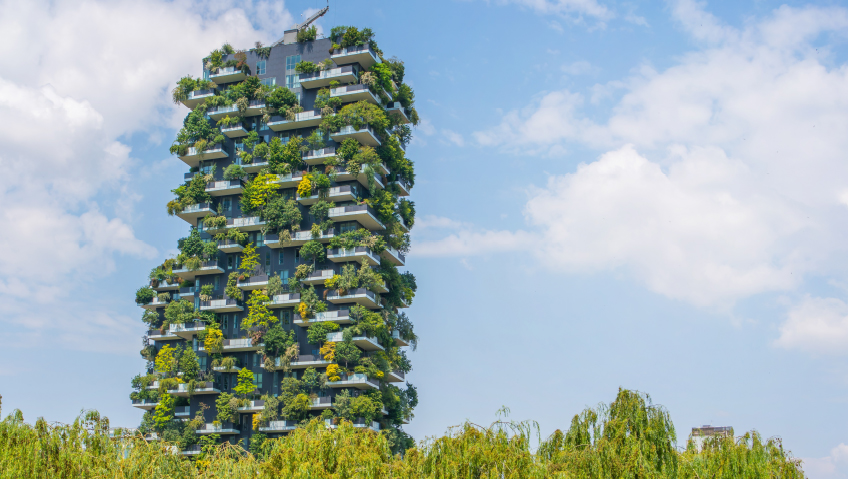
Sometimes called ‘vertical urbanisms,’ vertical cities boast myriad benefits because of their all-in-one designs. Rather than one building dedicated to residential space, another focused on offices, and still others designated for retail, entertainment, restaurant, sports, medical, or administrative spaces, vertical cities bring everything together in one highly functional complex. Redefining urban living, vertical cities like The Line in Saudi Arabia and Melbourne’s Southbank by Beulah effectively unite residential, commercial areas, and other elements. Some, like the innovative Bosco Verticale in Milan, focus on greenery, which improves air quality, fosters natural wildlife habitats, and showcases biodiversity.
As land becomes more expensive and increasingly scarce, large cities worldwide are having to build up, not out. Fast disappearing are the days of single-family homes in favour of skyscrapers, which enable greater density. This is especially evident in 569 skyscraper-strong Hong Kong; Shenzhen, China and its 468 skyscrapers; and New York City, home to over 300 skyscrapers. At 128 storeys and 632 meters (2,073 feet), the Shanghai Tower remains the tallest building in China, able to accommodate 16,000 people.
Along with more efficient land use by building up on a smaller footprint, vertical cities help to combat urban sprawl, congestion, and pollution. Combining numerous amenities in mega-structures means spaces are more efficient; instead of driving from one location to another, residents can walk, bike, or use integrated transit, saving time and money. And much like regular cities, vertical cities are self-sufficient, with their own water, sewage, and recycling systems built in.
Sarah Smith of Smart Cities Dive, which focuses on trends shaping today’s cities and municipalities, says vertical cities are “an entire human habitat contained in a massive skyscraper,” and that they “hold the key to solving overpopulation and overcrowding.” Although no one solution will ‘fix’ housing, vertical cities can go a long way toward addressing these and other issues.
Vertical cities are a natural extension of skyscrapers like the Shanghai Tower, and like massive towers, can go a long way toward alleviating housing shortages and overcrowding. Spread across multiple interconnected towers and millions of square feet, it is possible for vertical cities to accommodate 30,000 or more residents while using far less land than buildings of fewer floors. This is especially important today, with more and more farmland, ravines, forests, and other natural spaces being lost forever to massive new housing developments. In recent years, for instance, the Ontario government did an about-face on converting thousands of acres of protected land in the province’s Greenbelt.
Vertical challenges
Just like creating a skyscraper, building vertical cities is a major construction undertaking, and funding remains an issue. Vertical cities are not one-off buildings, but enormous projects that take years to construct. Depending on size, skyscrapers cost hundreds of millions of dollars, and more, to build; vertical cities require the same parameters, including the cost of land, paying for site surveyors, civil, mechanical, and structural engineers, permits and building codes, architects, and designers. And then there is the cost of materials like reinforced steel and aluminum, concrete, glass, insulation, drywall, plumbing supplies, electrical wiring, and more. To ensure utilities like HVAC, electricity, and water and sewage are consistently available to residents from the ground floor to the hundredth, mechanical systems must be designed to ensure consistency at all heights. This requires localized units, staged water pumping and intermediate storage tanks, chillers, heat pumps, and other costly mechanicals.
The enormous cost of vertical cities expands with the number of towers and their heights. Extremely tall buildings require dozens of elevators servicing different floors and sky lobbies. (Essentially transfer points in skyscrapers, sky lobbies save floor space and serve as transfer points between express and local elevators.)
Another consideration of living and working in a vertical city is maintaining one’s well-being, both physical and emotional. While having live and work amenities in one location is practical because it saves traveling time, it can lead to a sedentary lifestyle, since there is less need to go outdoors. This comes with several drawbacks, including a lack of social interaction and feelings of anonymity. Being indoors also means a lack of sunlight and disconnection from natural spaces such as parks, forests, and bodies of water. Depending on the time of day and how the towers are oriented, it is also possible to be in shadow for hours at a time.
Sky-high towers can greatly increase housing density and free up land for agriculture and nature, yet vertical cities must also be designed to balance functionality with a healthy lifestyle. Their success will ultimately depend on more than engineering feats or record-breaking heights. Natural light, access to green space, opportunities for social interaction, pedestrian-friendly environments, and connections to the world beyond the building will all be essential to creating places where people genuinely want to live.
As cities continue to grow and available land becomes increasingly scarce, the vertical city may offer one possible answer to the challenge of accommodating more people without endlessly expanding outward. By bringing homes, workplaces, services, recreation, and green spaces together within a relatively small footprint, these developments have the potential to make better use of land while reducing some of the environmental and infrastructure pressures associated with urban sprawl.
The concept is still evolving, and projects such as Nakheel Tower demonstrate just how difficult (and expensive) it can be to turn such an ambitious vision into reality. Yet the idea has endured. The vertical city is no longer simply a vision of a distant future but an increasingly important part of the conversation about how—and where—we will live as urban populations continue to rise. The challenge now is not simply to build higher, but to build smarter, creating complete, livable communities that balance density, efficiency, sustainability, and human needs.