America was a very different place when integrated design firm GGLO was founded in 1986. Shopping malls were the heart of many cities. Anchored by major department stores like JCPenney and Macy’s, these sprawling malls boasted stores with the latest fashions, record stores, food courts, video arcades, and more. Bursting with energy, they were places to meet after school and hang out with friends.
Forty years later, many of these once-bustling shopping malls have closed or are shadows of their former selves. Once-massive retailer Sears—which had about 3,500 locations nationwide at its peak—has been largely replaced by e-commerce sites and has just five full-line department stores remaining in the United States. So what lies ahead for these seemingly outdated spaces?
A new life for the oldest mall
For GGLO, the decline of shopping malls has presented exciting new opportunities, as in the spectacular revival of Seattle’s famous Northgate Mall.
In the post-World War II glory years, Northgate became the first shopping mall built in America. Like other malls, it vigorously expanded over the decades, at its busiest drawing tenants like Toys “R” Us, Foot Locker, and Nordstrom. Then the tide slowly began to turn, and by 2018-2019, large retailers like Macy’s and JCPenney announced they were closing.
But it wasn’t the end of the line. GGLO was approached by a long-time housing developer client who looked at vacant land, including large, empty parking lots surrounding the mall, and wondered if housing could be developed. Soon into this study, it was questioned if housing would be successful if the mall was to remain in its original form.
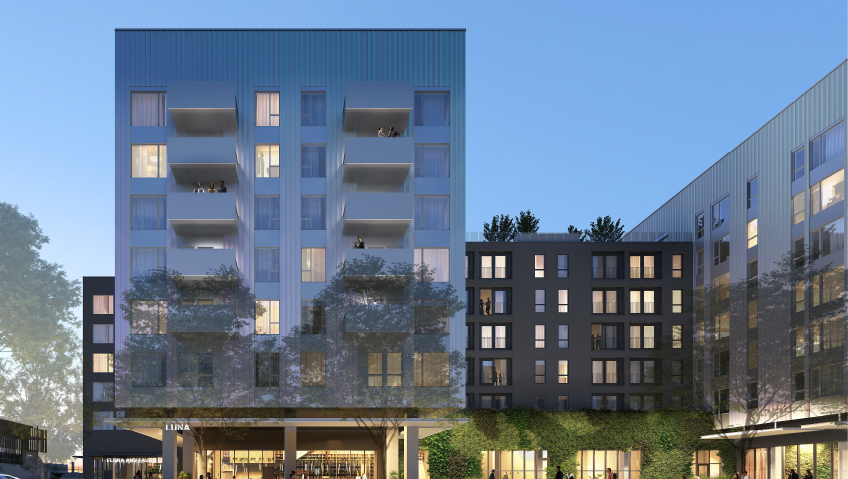
This question unlocked the opportunity to reimagine the 55-acre mall site into a mixed-use center with new residential housing, office, hotel space, and a community ice rink which is also the practice facility for the National Hockey League’s Seattle Kraken.
“The work we’re doing out at Northgate in Seattle is really transformative,” says Jon Hall, AIA, LEED AP BD+C & Homes, and member and principal of GGLO. In the works for about a decade, the massive project will continue for another 10 to 20 years. “It’s massive,” he says.
Just nine miles north of central Seattle, Northgate Mall (now known as Northgate Station) was recently connected to downtown Seattle and the airport with a light rail line. This rail line now provides transit access to and from this vibrant mixed-use area, which GGLO describes as innovative, contemporary, and “a transformative model for future mall conversions.”
With existing tenants like Starbucks, Chipotle Mexican Grill, Barnes & Noble, the Seattle Kraken Team Store, and Bank of America, and with the now completed first of four mixed-use apartment buildings, first of two new hotels, and future new tenants like Shake Shack and Mendocino Farms, Northgate is once again becoming a strong regional draw.
An integrated design experience
Renowned as one of America’s foremost multidisciplinary architectural firms, GGLO was founded by Bill Gaylord, Alan Grainger, Chris Libby, and Clayton O’Brien Smith, as reflected in the name “GGLO.”
Today, the GGLO team of about 50 includes architects, landscape architects, interior designers, and urban planners. Emphasizing the importance of environmental sustainability and social equity, the firm is truly a one-stop shop for its clients, many of whom are repeat clients. “We strive for an integrated design experience,” says Hall. “Everything from the outside to the inside, and everything from the scale of a 100-acre master plan to the cabinetry details on the interior of a clubhouse. No project is too big or too small.” Today, GGLO serves clients from its locations in Seattle, Washington and Boise, Idaho.
Celebrating his 30th year with the firm, Hall has watched the market evolve for decades, including a growing focus on sustainability and adaptive reuse of sites like Northgate.
Initially, Hall was drawn to GGLO because of its work in affordable housing. “It’s what attracted me. But what’s kept me here is the variety of the work we’ve done—everything from affordable to market rate to student housing, retail, and office.”
Along with more work in Seattle and Idaho, GGLO is experiencing growth in regions including Montana, Colorado, Wyoming, California, and throughout the West Coast. The reasons are often environmental and sustainability-related. Summers are getting hotter, and wildfires are worsening. Clients are increasingly concerned about air quality and healthy living. Some come to GGLO with knowledge of green design and construction, and some learn from GGLO staff about the benefits of incorporating energy-efficient designs and materials to reduce their carbon footprint and create structures which are not only aesthetically pleasing, but built to last.
“More than half of our clients are repeat clients, people we’ve been working with for quite a long time,” Hall explains. “But we also try to share our expertise at conferences and events, publishing information and stories, which helps draw new clients, finding people who align with our values and our culture. This includes suitability values, mixed-use/mixed-income values, and moving those things forward.”
Additionally, GGLO explores different sustainability initiatives and programs, including LEED, Living Building, and the American Institute of Architects (AIA) Framework for Design Excellence. With its 10 principles, “the framework informs progress toward a zero-carbon, healthy, just, resilient, and equitable built environment,” says the AIA.
Customers are also increasingly interested in HVAC and other energy-efficient filtration and cooling systems. “We focus on what the benefits are, whether it’s saving utility costs, lower maintenance, or a more durable building which is going to last them longer,” says Hall. “It’s not so much about the plaque as it is about the real, direct benefits they get out of doing something more sustainably.”
Clients are increasingly choosing more durable products, such as wood flooring instead of vinyl, solid cabinets instead of laminates. These materials require less maintenance and will last decades rather than years. This is especially valuable because so many of GGLO’s clients are long-term property holders, local non-profit and for-profit housing developers, Real Estate Investment Trust (REIT) companies, and family residential outfits, such as AMLI Residential and Vivmark Residential.
“While first cost is important, they recognize long-term maintenance and operation costs are also important, and they want to make sure they’re not spending a little upfront but too much down the road,” says Hall.
Transformative community projects
Over the years, GGLO has amassed a portfolio of unique projects, many concerned with repurposing existing land and buildings to meet future needs. In addition to its role in Seattle’s Northgate development, GGLO has been instrumental in the Spring District in Bellevue, Washington.
In an area known as the “Bel-Red Corridor,” the Spring District is moving away from its past as an industrial area into a reimagined urban neighborhood. To date, GGLO has been involved in the design of several area projects, including informing the urban planning, three market rate residential communities, one affordable housing community, and a brewpub/office complex for the local tech workforce. “It’s another large series of developments,” says Hall. Other companies have constructed additional office and residential buildings in the area, near the Meta (Facebook) campus.
The Spring District is located on the light rail line which has recently expanded to Bellevue and Redmond on Seattle’s east side. The new transit line connects to Seattle and Northgate Station as well as south to SeaTac Airport and the City of Lynnwood to the north of Seattle.
“It’s a whole new neighborhood which sprung out of what used to be warehouses and distribution centers,” Hall adds, “but now, it’s a real mixed-use/mixed income neighborhood.” As a long-term project which began in 2012, Hall estimates the developments may require GGLO’s involvement for another 20 years or more.
Another source of pride for the firm is the Schoolhouse District. Located in Woodinville, Washington, the Schoolhouse District is a mixed-use, multifamily development which includes a local historic site. It also highlights the success of a private-public partnership.
Blending past charm with modern amenities—and without releasing some of the embedded carbon of the area’s original structures—GGLO helped create a dynamic neighborhood with living spaces, restaurants, a farmers market, sports fields, a daycare center, retail shops, and Wine Walk Row.
The original site included an underutilized 1970s masonry school and an abandoned 1930s-era schoolhouse. The project team repurposed some of the existing structures to preserve the local history of the site and create a catalyst for a new neighborhood. Artwork featuring reclaimed items from the historic schoolhouse is integrated throughout the buildings as a nod to the site’s heritage as well as the custom mural in the lobby which showcases the evolution of Woodinville through chalk art. A new market rate housing development adjacent to the existing playfields provides 264 homes for families in this community northeast of Seattle.
As with many other projects, the Schoolhouse District saw GGLO receive awards, including the CREDAWA Mixed-Use Development of the Year (2022) and the Multifamily Executive Grand Award: Multifamily Project of the Year (2022).
Building the future
For the team at GGLO, malls, former industrial sites, and land which is underutilized or vacant are all becoming prime candidates for redevelopment. “Affordable housing is going to continue to be a need, and we’re seeing it across the country,” says Hall. The firm is thus presently working on developments in many areas, including Jackson, Wyoming and Sun Valley, Idaho. “I see us continuing to expand across the West. We still have developments in California, as challenging as they are, and in Arizona and Montana. Our work across the West is going to continue,” he shares.
As for the future, Hall believes the office market is changing. Many cities, such as Seattle, still have vacancies in office buildings long after the pandemic, and little new construction. “In the current conditions, a lot of our clients are focusing on renovation and rehabilitation of their projects, rather than new construction,” he says.
“We’ll continue to see this kind of adaptive reuse of office buildings, transforming them into something other than 100 percent office use. Maybe they become residential, maybe retail, but they will become something other than what they are.” GGLO will be there to lead the way, bringing together the visions of both clients and communities.