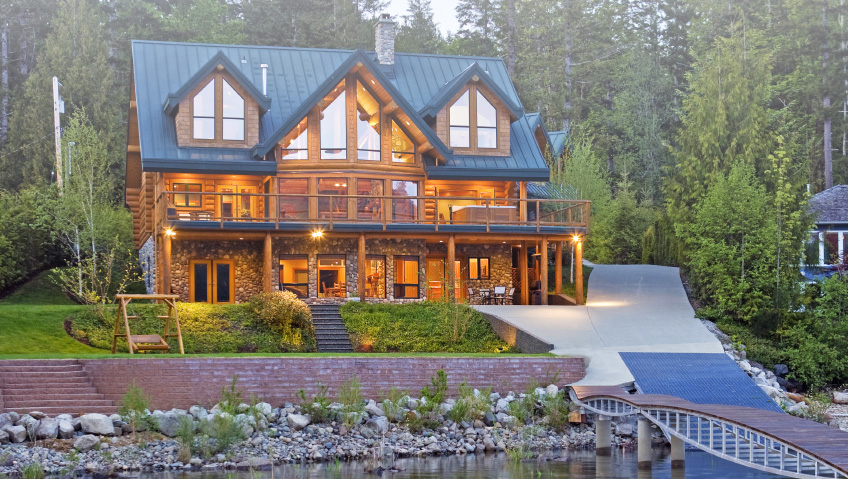
Once associated with the simple hand-hewn efforts of pioneers—and now often assumed to be beyond the average client’s price range—today’s log homes represent timeless, handcrafted beauty. Thanks to Norse Log Homes and its dedication to affordability, this beauty is available in a wide range of price points and countless design options. When it comes to constructing the ideal log home, whether a distinctive office structure, a cabin resort complex, a mountainside ski chalet, or a cabin on a remote lake, Norse’s builders are highly skilled in both design and construction, able to tailor to custom specifications at competitive prices without compromising on style or elegance.
Building since 1979, Norse Log Homes relocated to Vancouver Island in 1984 to be near the best supply of house logs in the world. The company uses primarily Douglas Fir but also Western Red Cedar and yellow cedar depending on the purpose and customer’s preference. Exporting a lot in the ’90s, Norse Log Homes ran three tower cranes on two yards and built about 40 homes a year. Today, the company runs out of one yard and offers more than just log packages—it helps customers reach a variety of building stages based on location and how active the customer wants to be in their build. Norse Log Homes often handcrafts about 12 projects annually, with highly qualified artisans building custom projects spanning a wide variety of sizes.
“My dad’s goal was that everyone should be able to afford a log home,” says President Laura Kandall, whose father, John Dahle, took over the company and relocated it to the Island in 1984. “It wasn’t just for the rich. He was trying to create something that was a good product for a fair price, and he was able to do it.”
Because Dahle was adept at keeping costs down, he could sell products at more competitive prices, a practice that Kandall continues to employ in the business today, in part by tracking external costs such as log export pricing.
And while labour is expensive in British Columbia right now, the actual log wood that is utilized in the houses is not exorbitant. “Logs are really economical to build with,” says Kandall. Additionally, while some construction companies rent all their equipment, Norse owns its own tower crane in its yard and a crane truck for setups, which helps the company remain fair and competitive with both pricing and time.
Based in British Columbia, Norse has sold homes around the world to devoted enthusiasts, including Japanese clients who “love log homes because they like Canadian wood,” says Kandall, noting that log homes are also notoriously well-suited to withstand earthquakes. Norse has also built in Hawaii, Ireland, and extensively in the United States, as well as in the Yukon, Manitoba, and all across Canada.
The company’s unique process starts with pre-building homes in its yard in Lantzville, then taking about a day to number and disassemble them and load them onto a truck or container for shipping to a waiting foundation anywhere in North America or around the world. After reaching their destination, it takes another day or two for setup.
Norse’s projects come in any size, says Kandall. This year alone, the company built both a sauna under 100 square feet and a 5,500-square-foot house delivered into the mountains of Colorado at 11,000 feet above sea level. In addition, Norse completed Santa’s Village in its neighbourhood mall as well as several other projects, including playgrounds for children, picnic tables, and gazebos, as well as retirement homes and single-family cottages.
While the company has built large houses and commercial projects before from beginning to end, its customers often finish the houses themselves, with Norse building the log package or handling the foundation, roof, windows, and exteriors and the customer finishing the interior flooring, electrical, plumbing, kitchen, and bathrooms.
When it comes to using logs versus traditional home-building materials, Kandall finds Norse clients are generally health-oriented or conscious about how they live, which dictates their desired dwelling. “A lot of people don’t like the chemicals in houses,” she says, which include manufactured beams and drywall. “I’ve got a lot of customers who don’t like the idea of drywall in their home. They like the idea of using solid wood and knowing where it came from. Additionally, the logs we’re using are handled very little, keeping handling costs down.”
For those desiring energy-efficient homes, logs are already a low-carbon building material due to their minimal handling and the way carbon is stored within a log. “We have a home we’ve proven over time can be really energy-efficient and have a low carbon footprint in our world,” says Kandall. “I think people are gravitating toward those more natural building materials if they can.”
Not only does Norse provide those sought-after natural products, it also personally oversees the entire process. “Logs are coming from the bush. They’re cutting them down in the bush, putting them on a truck, and taking them to the sorting yard. They’ll sort them by quality and size, and then they bring them to us, and we cut them all in-house,” Kandall explains.
Norse does all the peeling and cutting with a chainsaw, allowing for minimal handling of the wood. In comparison, a framed home’s dimensional lumber represents a much heavier manufacturing and logistical footprint.
For those concerned about price, they may need to take a closer look. While many people assume log homes are out of their reach, in fact they’re very similar to traditional homes. “When building a house, a lot of the cost is the same, whether it’s a log home or a framed home,” Kandall says. “If you were going to take a house and make it into a log home, you’re just getting rid of your exterior walls, so all of your site work cost is the same: hookups for utilities, foundation cost, roof, windows, doors, all of your interior finishing—it costs the same.” The big difference is that those exterior walls are made of logs, so you no longer need framed 2-by material, plywood, building paper, rain screen, siding, interior drywall, interior insulation, or interior trim—all of it is replaced by logs.
Essentially, everything Norse does today stems from John Dahle’s initial commitment to ensuring the homes remain affordable for anyone who wants one. “He’d meet people who wanted a little hunting cabin or fishing cabin, and he would always find a way to make it work with their budget,” Kandall says.
Clients may want Norse to supply a log package and nothing more, meaning Norse doesn’t put a roof on the structure or install windows and doors, and those customers arrange all of that themselves. Or they may want Norse to pair with a general contractor and complete the entire building. Each build is customized to the client.
And not only does the finished product look beautiful, but it can also last a lifetime. “A lot of people realize these can be a really nice, generational home for their kids and their grandkids.”
However, it’s vital to utilize a good design when building any log home, especially in British Columbia’s climate, stresses Kandall. “We call it the ‘wet coast.’ It rains all the time, so the design is really important.” This can include employing proper style, such as overhangs, leaving space for corners and window sizes, and employing a skilled builder who will do a good job constructing it.
Then there’s maintenance to consider, she adds. “With any wood-sided building, there’s some care that goes with it. But to have something last a really long time, you need all of those things. If you don’t have a good design or build properly, your maintenance will be very heavy, and you need to be prepared for that. But if you have all three of those things, it doesn’t take a lot of time for maintenance if the design is good.”
As one might imagine, skilled and knowledgeable log home builders are both hard to find and hard to train. “Because it’s such a specialized thing to do, the training has to come in-house,” Kandall explains. “To get good at it, it takes years.”
As in all trades, a lack of high school-level training and a failure to encourage students to pursue trades at a higher level are felt everywhere across many industries. Fortunately, high schools are starting to put trades back into the curriculum, Kandall says, but in British Columbia, there still aren’t a lot of young people coming out of school with enough experience. Additionally, the skill behind designing and building these amazing structures could be endangered if the outgoing generation of workers fails to pass that knowledge down. But, while once considered a dying trade, Kandall has seen a recent spurt of popularity in log homes, with longstanding companies being bought by younger people who are “making a go of it.”
“My dad passed away years ago,” she says. “There are a lot of skills lost when you lose that generation, and a lot of the designers designing houses right now have never actually built log homes before, so they’re designing blind. They can do the computer program to put a house together, but they don’t really understand it when they’re designing it.”
Kandall’s goal is to keep those invaluable skills—and that passion—alive, while showing clients the beauty and affordability possible through Norse’s log homes. “I’ve gone to look at houses we built 40 years ago, and the sense of accomplishment I have from looking at buildings we put up that long ago that are still in amazing condition is incredible,” she says. “You wouldn’t even know how old they were. If you take care of a log home, it can last hundreds of years.”