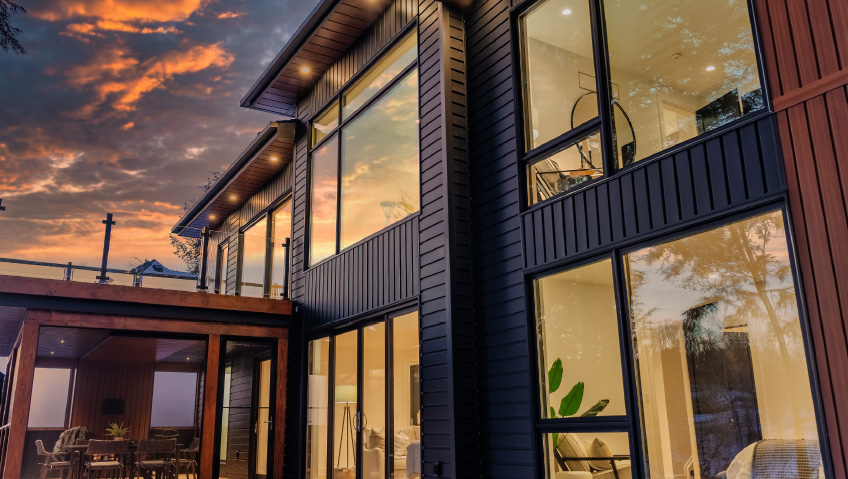
When Kyle Newman talks about building homes, he rarely starts with square footage or finishes. Instead, he talks about legacy and time—about responsibility to families, communities, and the land itself.
As CEO of Stratton Homes, Newman has helped shape a company that quietly challenges how residential construction is approached in Ontario’s cottage country and beyond. Alongside Director of Operations, Morgan Shaver, and the steady onsite force behind the builds, Stratton Homes has grown into a builder known for Net Zero Ready construction and a deeply intentional approach to people, from tradespeople to homeowners.
Together, Newman and Shaver balance the big picture with the day-to-day realities of building, blending long-term vision with practical, onsite experience.
Stratton Homes officially began in 2014, shortly after Newman and his wife Kristin returned to the area. Not long after launching, Newman was offered a partnership opportunity with a high-end luxury home builder, an experience that, while professionally valuable, ultimately clarified what he didn’t want.
“I realized I wasn’t building the things I loved or leaving the legacy I wanted to be part of,” Newman explains. At the same time, life outside of work was changing. With young children at home, the demands of large-scale operations and constant pressure left him feeling disconnected from the moments that mattered most.
In 2019, just before the pandemic reshaped the world, Newman made a decisive move: he sold his ownership stake and stepped away. COVID provided an unexpected pause, time to reassess and rethink what a home-building business could look like if it was designed intentionally from the ground up.
Forging a team
The connection between Newman and Shaver didn’t begin in a boardroom. It started with families crossing paths through casual conversations about building and mutual curiosity. Shaver, a hands-on builder with deep technical knowledge, had been quietly constructing his own home, largely on his own, an effort that immediately caught Newman’s attention. “There’s no way,” Newman remembers thinking when he first heard about it. But it was real—and impressive.
During the pandemic, a simple social media post asking for help with tile work led Newman back onto a job site. One project turned into conversations. Conversations turned into a spec build. And that build became the real beginning of Stratton Homes as it exists today.
Shaver now serves as Director of Operations, spending most of his time on jobsites working directly with trades, supervising builds, and ensuring the company’s standards are upheld from foundation to finish. “I’m not the silent partner,” Shaver says, “but I’m definitely the one on the ground.”
Newman’s experience managing teams of 60 or more taught him an important lesson: scale doesn’t automatically equal efficiency. In fact, too many internal layers often pull attention away from what actually matters: the build itself. Stratton Homes thus operates with a tight group of site supervisors and a carefully selected roster of dedicated trades and vendors. Many of these partners work exclusively with Stratton, a decision rooted in trust, consistency, and shared standards.
The analogy Newman often uses is hockey. “You can take the best players in the country and put them on the ice together, and at first it’s a mess,” he says. “But give them time, and suddenly they’re passing without looking.” That familiarity pays dividends in quality, efficiency, and morale. Tradespeople know that when the Stratton team says a site is ready, it’s ready. Schedules are tight, sites are organized, and payments are fast, net 15 via direct deposit, an industry rarity. “We hear it not just from business owners, but from their employees,” Newman says. “They’re excited to come to our sites.”
Building with—and for—nature
At Stratton Homes, Net Zero Ready construction isn’t a premium add-on; it’s the starting point. Rather than reinventing the wheel on every project, the team uses a standardized building envelope and wall assembly across all builds, regardless of budget or client type.
“Whether you’re a $5 million client or we’re building for Habitat for Humanity, the wall assemblies are the same,” Newman explains. This consistency simplifies execution and ensures predictable performance. High-quality triple-glazed windows, carefully designed insulation systems, and airtight construction are integrated by default, not upsold later.
Shaver has lived the difference firsthand. “The performance gap between good triple-glazed windows and lower-quality ones is night and day,” he says.
Beyond operational efficiency, Stratton Homes is increasingly focused on embodied carbon, the environmental impact of materials, from production through installation, and actively evaluating materials that sequester carbon rather than emit it.
In Muskoka, landscape is everything; lakes, granite, forest, and elevation define the region’s identity, yet too often, homes are built by clearing first and designing later. Stratton takes the opposite approach. Before a single tree is cut, Newman and Shaver walk the site together, identifying rock formations and critical trees worth preserving. Homes are designed around the land, not imposed on it. “It makes the build harder,” Shaver admits. “It can add weeks to logistics. But when the house is finished and the trees are right there, you can’t buy that.”
For Newman, the math is simple: trees take decades to grow. Removing them prematurely is a missed opportunity both aesthetically and environmentally.
Clever customization
The Stratton team understands that customization can be one of the most overwhelming parts of building a home: hundreds of decisions; endless options. Fatigue sets in quickly.
Stratton’s solution is its pre-sale interior design program: seven curated design packages, all priced the same, all built from the same trusted brands and suppliers. “Pick your vibe,” says Newman. “That’s it.”
Developed in collaboration with interior designer Carolyn Wilbrink and Stratton’s internal team, the packages allow homeowners to personalize their space without the stress of designing from scratch. Shaver likens it to buying a vehicle. “You can get an F-150 in different trims: Lariat, King Ranch, Tremor,” he says. “You’re still customizing, but you’re not rebuilding the truck from the ground up.”
From an operational standpoint, the benefits are significant. Once a client selects a package, purchase orders are issued immediately and materials are ordered, warehoused, and ready, eliminating delays and supply chain surprises.
Aiming for efficiency
Trends, according to Shaver, are shifting away from excess. “People are leaning toward smaller, smarter homes,” he says. “Less square footage, more efficiency.” Shaver himself recently downsized from a 3,300-square-foot home to 2,100 square feet and wouldn’t go back. “Our utility bills are about $160 a month, year-round,” he notes. “I can leave for two months, and the house just runs.”
Low-maintenance materials and thoughtful design are replacing size as the true markers of comfort. One standout example: Shaver’s slab-on-grade home. Instead of installing in-floor heating, long considered essential, he added six inches of insulation beneath the slab. “It feels like a regular subfloor,” he says. “But I don’t have to maintain it for the next 50 years.”
Perhaps the clearest expression of Stratton Homes’s mission is its work with Habitat for Humanity Ontario Gateway North. Convincing an affordable housing organization to pursue Net Zero Ready construction required careful justification, but the math spoke for itself. “If you spend $30,000 more upfront and save that in monthly operating costs, it’s not an upgrade,” Newman explains. “It’s responsible.”
The result: Habitat for Humanity Ontario Gateway North’s first Net Zero Ready homes, compact and efficient units designed to minimize long-term costs for residents.
The future of housing, according to Newman and Shaver, lies in efficiency at scale. Recent visits to advanced prefabrication facilities revealed AI-driven systems capable of optimizing entire builds in minutes, minimizing waste and dramatically reducing labor requirements.
“They uploaded a floor plan,” Newman recalls. “In under a minute, the system had optimized every component.” Robots don’t build the homes outright (yet), but they fabricate components with astonishing precision. Offcuts are repurposed and waste is nearly eliminated. Homes can be assembled in hours, not weeks. For a country facing a housing shortage, the implications are enormous.
Interestingly, one of Stratton’s fastest-growing areas wasn’t part of the original plan at all: sustainable resorts. From Net Zero glamping communities to spa-integrated forest retreats, developers are increasingly seeking builders who can deliver low-impact, high-performance structures in sensitive environments. “These projects let us show there’s another way to build,” Newman says. “Even for high-net-worth clients.”
Ask Newman what ultimately drives him, and the answer isn’t growth for growth’s sake. “It was never about owning an island,” he says. “It was always about building attainable, sustainable homes,” ones that feel normal, comfortable, and beautiful but quietly perform better, last longer, and cost less to operate.
With Shaver anchoring operations onsite and a company culture rooted in trust and purpose, Stratton Homes is proving that thoughtful building isn’t just possible; it’s scalable. And in an industry ready for change, that might be the most important foundation of all.