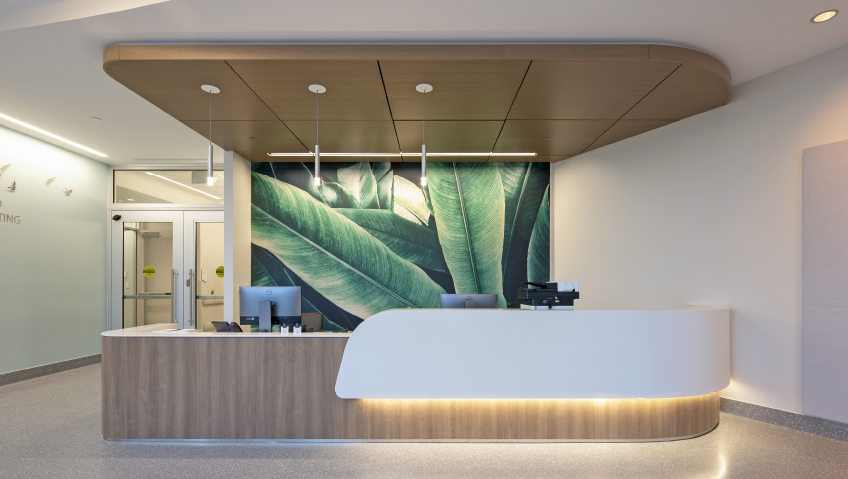
For more than 46 years, Adams Group has grown from a small, family-run cabinet shop into one of the Southeast’s leading manufacturers and installers of commercial casework, architectural millwork, and solid surface solutions.
Founded in 1978 by two brothers in Ohio, the company originally handled residential cabinetry before relocating to Florida and, under the leadership of Ethan Adams, pivoting entirely toward commercial construction. Today, as a second-generation, family-owned organization, Adams Group employs 156 team members and serves clients across a broad region in the fields of healthcare facilities, universities, sports complexes, and other complex commercial environments.
Adams Group was incorporated in Florida in 1984, and as opportunities grew, the company shifted its focus exclusively to commercial construction projects. Its geographic reach and capabilities have expanded well beyond that original footprint, and what began primarily as a casework operation now includes custom architectural millwork, solid surface fabrication, specialty solutions, project management, drafting, engineering support, and installation services, all delivered under one roof.
That integration is central to how the company describes itself: not simply as a manufacturer, but as a full-service partner capable of carrying a project from concept through completion.
Adams Group’s mission statement, “Building Beautiful Environments. Thriving Relationships,” is more than a marketing tagline. According to Human Resources Manager, Tara Szatkowski, the mission drives daily decision-making across every department, from estimating and drafting to manufacturing and field installation.
Szatkowski has spent a decade with the organization and says the people-first philosophy runs through every level of the company. “It is definitely all about our people,” Szatkowski says. That focus shapes not only how the company treats its workforce, but how it evaluates candidates during the hiring process.
“We look at whether they are humble, hungry, or smart,” Szatkowski says, describing the traits Adams Group prioritizes when building its team. Those same values, expanded to include “wise,” also form the foundation of the company’s internal playbook and guide how employees collaborate, solve problems, and serve customers. Adams Group encourages team members to listen first, take ownership, continuously improve, and prioritize long-term outcomes over short-term gains.
Szatkowski describes the company as one that has resisted the impersonal drift that often comes with growth. “We still care about each individual,” she says. “We know a little bit about each person, who their spouses are, who their children are, who’s having babies, who’s getting married, who may be going through a difficult time.” She points to the company’s willingness to organize fundraisers for team members facing financial hardship, medical difficulties, or family loss as evidence of that commitment in practice. “That’s how we as an organization help to build those thriving relationships within the organization,” she says.
Another defining feature of Adams Group’s business model is its integrated service structure. Rather than functioning purely as a manufacturer, the company provides estimating, drafting, engineering support, project management, manufacturing, solid surface fabrication, and installation, all coordinated through a single organization. Szatkowski describes this as something close to a one-stop shop experience for clients, one where they can watch a project develop from the earliest drafting and engineering stages through manufacturing and into installation, with a project manager involved throughout. “A PM is with the project throughout the process,” she says, noting that installation teams in the field are ultimately responsible for realizing the vision established earlier in the process.
Executive Vice President, Curt Bennett, expands on the benefits this structure provides to different stakeholders. For owners, the integrated approach means fewer handoffs, better coordination, and a single point of accountability instead of multiple vendors to manage. For architects and designers, early collaboration with Adams Group’s drafting and manufacturing teams allows practical feedback on constructability while preserving design intent. For general contractors, having one trade partner responsible for multiple scopes simplifies scheduling and reduces the coordination challenges that can arise when many vendors are involved on a single project.
Szatkowski credits this cohesion for much of the company’s staying power. “We would not be where we are today if it wasn’t for each piece of that puzzle working together,” she says, pointing to the collaboration between estimating, drafting, engineering, the manufacturing shop, and the departments that follow.
To keep it all running smoothly, Adams Group has continued to invest in automation and digital tools. On the production side, the company stays current with commercial equipment, including robotics and machinery that generate data used to refine workflows. On the administrative side, the focus has shifted from simply storing information toward building repeatable workflows and processes that scale as the company grows. John VanErem, Executive Vice President, notes that the real investment in digital workflows lies not in the cost of the tools themselves, but in the effort required to put them to full use across the business rather than testing them on the margins.
Szatkowski notes that artificial intelligence has been introduced in select areas of the organization rather than applied uniformly. Her own department uses it in HR functions, and the accounting team recently implemented new AI-driven capabilities to help manage monthly invoicing. “We have used it in different branches of the organization,” she explains, “but it’s not used throughout the organization.”
In a competitive commercial millwork market, Adams Group positions itself as something broader than a manufacturer. Christopher Wernimont, Operations Engineer, describes the company as a relationship-driven organization that combines the capabilities of a large operation with the personalized attention of a trusted partner. Over more than four decades, Adams Group has built a reputation for quality craftsmanship and exceptional service while continuing to invest in technology, innovation, and process improvement, and that combination is a matter of continuous improvement as much as scale. Adams Group describes itself as committed to finding better ways to increase efficiency, solve challenges, and deliver greater value to its customers, all while maintaining a people-first culture. The company places its clients’ trust as central to that commitment, with the goals of anticipating challenges, delivering on commitments, and building long-term relationships that lead to repeat business.
Ultimately, the leadership team notes, what sets Adams Group apart is not only what the team builds, but how it builds it, with quality craftsmanship, integrated services, continuous improvement, and a steadfast commitment to relationships.
With skilled labor remaining one of the construction industry’s persistent challenges, Adams Group has built a deliberate pipeline for developing new talent. The company partners closely with Pittsburg State University in Kansas, which offers degree programs in wood technology and related fields, to connect with students entering the industry.
Szatkowski describes an internship structure designed to give students broad exposure before narrowing their focus. Typically, the company brings on two to three interns each summer. Students who have declared an interest in a specific path, such as project management, can concentrate their internship there, while others rotate through multiple departments to see how each operates.
Near the end of the summer, interns are generally given the option to return to whichever department, or departments, resonated with them most, whether because of the work itself or the people they worked alongside. “It gives them the ability to see a little bit of everything,” Szatkowski says of the program’s design.
Bennett, VanErem, and Wernimont tell us that employees are given the opportunity to see the direct impact of their work because Adams Group manages projects from concept through installation. That visibility, paired with opportunities to expand skills across manufacturing, project management, drafting, and field operations, is central to both attracting and retaining talent. Retention, they say, ultimately comes down to culture and an environment built on respect, teamwork, accountability, and continuous improvement.
Bennett highlights the Naples Beach Club Market Square and the Doak Campbell Stadium renovation. The Naples Beach Club Market Square project featured high-end finishes that highlighted the installation team’s craftsmanship and attention to detail, and it required close coordination between project management and field operations to meet a demanding schedule.
The Doak Campbell Stadium renovation, meanwhile, showcased the drafting and engineering team’s ability to integrate a range of finishes and material types into a cohesive, buildable design, while the manufacturing team delivered high-end products at scale without sacrificing quality.
Szatkowski speaks more broadly about the sense of purpose the team draws from its work across the board. “Our team is proud of every project that we do,” she says, describing the satisfaction that comes from contributing to spaces built for hospitals, schools, and other community institutions. This connection to the communities Adams Group serves, she says, is a significant source of pride companywide.
Of course, client retention is closely tied to the same relationship-driven culture that shapes the company’s internal operations, and Szatkowski attributes much of the company’s repeat business to its people and its approach to customer service. “I think the longevity of some of our people and the customer service that we provide in the entire process keeps clients and customers coming back,” she says.
She acknowledges that projects do not always go exactly according to plan but says the company’s response in those moments matters as much as the outcome itself. “Even if everything doesn’t go exactly according to plan, they know that we will do our best to make it right,” she says, whether the issue originates on the job site, in the drawings, or in the manufacturing shop.
In addition to this level of trust and transparency, sustainability has become an increasingly important consideration for Adams Group’s clients. VanErem describes the company’s approach as one rooted in quality and long-term performance, supporting projects that use FSC-certified materials and contribute toward LEED certification requirements when specified, while adhering to Architectural Woodwork Institute standards to ensure durability and precision.
Looking ahead, the company’s recent acquisition of Mill-Rite Woodworking has expanded its capabilities in specialty wood and stone fabrication, solid wood moldings, and high-end veneer work, positioning Adams Group for continued growth in the high-end commercial interiors market.
Reflecting on the company’s history, Szatkowski points to its longevity as an accomplishment, particularly within an industry known for its sensitivity to economic cycles. “It’s safe to say that sustaining for 48 years is a feat in itself,” she says. “Especially in the construction world, construction ebbs and flows with the economy, and Adams Group has stayed strong.” She credits that stability to the leadership of Ethan Adams, who took over the company from his father and uncle and steered it toward the commercial focus that defines Adams Group today.
Bennett, VanErem, and Wernimont close on a similar note, describing a legacy Adams Group hopes to build that extends well beyond the buildings it constructs. The company aims to be known not only as a manufacturer or installer, but as an organization that develops great people, creates opportunities, and makes a positive impact on everyone connected to it.
As the marketplace continues to change and technology continues to evolve, the principles that have shaped Adams Group since 1978—integrity, continuous improvement, servant leadership, exceptional craftsmanship, and a commitment to helping people thrive—are expected to remain constant.
For a company built on the belief that beautiful environments and thriving relationships go hand in hand, that continuity may be its most defining trait.