Building a construction company is one thing, but establishing a family legacy that spans generations needs more than wishful thinking. It’s about maintaining a reputation for quality, on-time/on-budget project delivery, developing future leaders, and long-term succession planning.
For many, building is in the blood. Over the years, Construction in Focus has profiled many family-owned and operated firms across North America. Some choose to remain small, boutique-style businesses, taking on a handful of luxury residential projects a year to ensure quality and control. Others have expanded to distinct divisions and multiple locations across Canada and the United States, taking on everything from multi-million-dollar buildings to bridges. Even with their size differences, though, many started off the same way: as one-person operations armed with a pickup truck, a toolbox, and a dream.
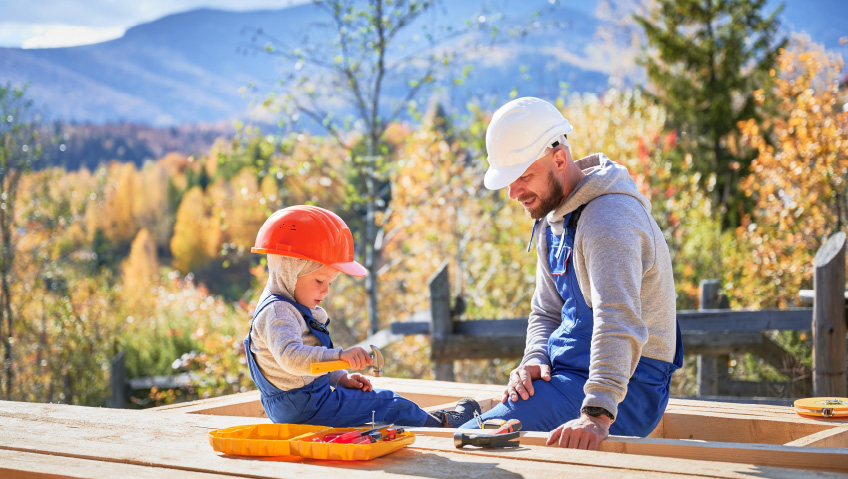
It isn’t unusual for many second, third, fourth, and even fifth-generation construction companies to bring on family members and start them at the bottom. Ask around, and you’ll find many construction company owners, presidents, and CEOs who remember working as kids after school and on weekends with their dad or uncle picking up wood, drywall pieces, and other debris. Although some say they missed out on regular childhood activities like playing with their friends, many admit working with family was the best thing that could have happened, because it prepared them for their future in construction.
Watching carpenters, plumbers, electricians, and other trades, these kids learned how to do things right, and more importantly, they learned what not to do and the importance of safety. Many watched workers using hammers and drills, framing walls, pouring concrete, and fishing electrical wiring behind walls. And when they weren’t tidying things up or watching tradespeople, many spent time at the office. There they saw invoices being prepared and construction supplies like wood, copper pipe, wiring, and screws being ordered. Combined with being on job sites, it was an education unlike any other.
In the traditional sense, younger family members learn by doing. This type of informal skill transfer comes from being immersed in work, asking plenty of questions, and making mistakes. Although less common today, many kids in the past learned which tool was best for the job long before they entered their teens.
Today, much of this hands-on, trial-and-error learning is supported by formal education in a trade school or college. Often, family members who show promise and a genuine interest in the industry also choose to take construction-related courses.
And it’s a good thing, too; decades of promoting white-collar careers over blue collar jobs—combined with many veteran tradespeople retiring—has resulted in a dire shortage of skilled workers across North America. In Canada, federal and provincial governments are encouraging skilled trades as a career path, with over 300 designated trades to choose from, 54 of them Red Seal. These include not only construction but transportation, manufacturing and industrial, and the services sector. Financial support, in the form of loans and funding programs, is also available. In Canada, it is estimated that one in six job openings will be in skilled trades-related occupations by 2034.
With a wealth of courses, students are exposed to many construction-related disciplines. Depending on their interest, they can immerse themselves in hands-on training in carpentry, masonry, welding, HVAC, and other trades. Others may be better suited to classes in construction or project management, cost estimating, construction engineering, surveying, architecture, drafting, or safety. And for students with an interest in technology or green building, they can pursue Building Information Modeling (BIM), drone operation, sustainable construction, modular building, and LEED certification.
One characteristic of family-owned construction companies is their core values, and this is especially important for smaller builders and renovators, whose word is their bond. For smaller builders, just a few projects delivered late, over budget, incomplete, or poorly done can ruin a reputation in an industry where you are only as good as your last job. This is why many family-run builders emphasize quality, integrity, safety, a commitment to innovation and continuous improvement, accountability, and respect for workers, customers, and the environment.
It is this value system that steers many family businesses and informs decisions from the job site to the head office. Adhering to these values pays off over time with employees, suppliers, subcontractors, and clients who demonstrate loyalty through repeat work. Many people can be trained to work in the trades, but if they have a poor attitude or aren’t onboard with a company’s values and mission, their construction careers will be brief.
For family-led construction companies to endure, they must not only get the next generation involved but ensure younger relatives—be they children of the founder, nieces, nephews or others—are informed about what is expected of them. We’ve all heard the idiom ‘handing over the reins,’ but transferring responsibility to someone else is never simple, nor should it be.
For retiring construction company founders, ‘emeritus’ is sometimes more than an honorific. If possible, the original owner being called upon occasionally for advice or guidance can work, provided that person is also willing to relinquish some control, which can be a challenge. And if the man or woman who built the company isn’t happy with the way things are being handled, that person often isn’t shy about letting others know.
Smart succession planning doesn’t start weeks or months before owners announce their intent to retire, but years. Even with smaller construction firms, much more planning is involved than simply naming a replacement. Long-term transference requires plenty of questions: where will the business be in the next few years? What skills are needed by the next generation? Is there a governance structure in place? How will the succession affect existing employees? These questions, and many others, need to be documented and supported by the existing leadership and the next generation.
Proper construction company succession requires honesty. It isn’t enough to simply name an heir; the future of the business depends on selecting someone who is both capable and committed, with a clear vision for what comes next. In some cases, that successor may not be an immediate child, but a grandchild, extended family member, or even a trusted employee who has earned their place through years of dedication and leadership.
Ultimately, legacy in construction isn’t defined by how long a company has existed, but by how well it adapts to what’s next. Many firms have weathered economic downturns, shifting markets, and generational change, only to falter when succession is treated as an afterthought. The most enduring family businesses recognize that succession planning is less about stepping away and more about moving forward. By investing in the next generation, reinforcing core values, and planning years in advance, family-owned construction companies can ensure that what began with a single truck and a dream continues to stand strong for decades to come.