In 1970, singer-songwriter Joni Mitchell released Big Yellow Taxi. The song’s sentiments reflected the North American construction craze of the era: “They paved paradise and put up a parking lot… don’t it always seem to go that you don’t know what you’ve got ’til it’s gone?” As it turns out, it took a few decades before we would learn that paving everything in sight is perhaps not as sustainable a solution as urban planners had originally anticipated.
Following years of climate change and the growing threat of urban flooding, cities across the Netherlands have been forced to confront the consequences of excessive paving and concrete. These hard, non-absorbent surfaces prevent rainwater from soaking into the ground, leading to significant runoff during heavy storms and increasing the risk of damage to both public infrastructure and private property.
In response, a broad consensus has emerged among Dutch urban planners, who are now working to remove non-absorbent, man-made materials from sidewalks, city squares, and parks. By exposing and revitalizing the underlying soil—and reintroducing plant life—planners aim to make urban spaces more permeable and resilient. The goal is to create cities that function more like sponges, better equipped to absorb heavy rainfall and withstand extreme weather events with less disruption and destruction.
So far, the country has come up with what seems to be the most playful yet ecologically sound and effective way of achieving the goal—one that is well worth emulating here in North America. Now, while bitterballen, Gouda cheese, clogs, tulips, and a love of cycling are only a few of the things that shape the Dutch identity, the “Nederlanders” are also known for their outstanding water engineering and, more recently, the National Tile Whipping Contest.
The concept is delightfully straightforward and a lot of fun. Every year from around March 21st until the end of October, 203 municipalities out of a reported 342 compete for the honor of winning the “tile whipping” (tegelwippen) contest’s golden spade. The initiative, developed by Amsterdam’s Frank Lee, a creative agency whose innovative idea came about during a COVID-19-period brainstorming session, has caught on like wildfire as people and cities leap at the opportunity to create more regenerative spaces where they can spend time connecting with nature.
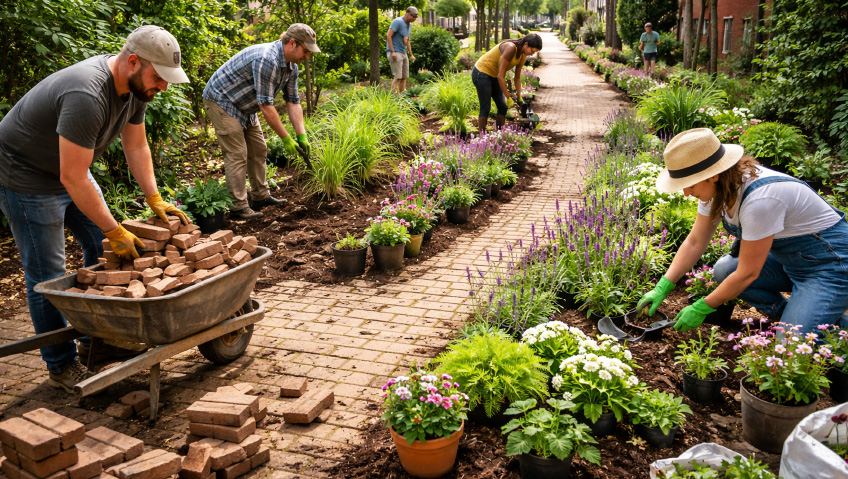
Today, it is common to see neighbours across the country take to their sidewalks with crowbars and wheelbarrows full of plants, turning dreary no-man’s lands into green spaces of community, creativity, and human connection. It is no wonder, therefore, that tile whipping is now just about considered a national sport.
The Dutch, and more recently, the Flemish, have been competing since 2021, removing nearly 6 million and 1.5 million tiles respectively in 2025 in what is known as the Derby der Lage Landen, a name given to any sporting match between the Netherlands and Belgium. Supporting the initiative is an informative website that guides citizens on what to do and what not to do, while explaining how soil is enriched and plants are grown. Local municipalities also provide tile taxis to remove pavers from such sites. Last year, citizens in Utrecht removed nearly 440,000 tiles, making it the winner in 2025.
Removing hard surfaces is not the only strategy cities are using to address the problem of non-absorbent paving. In many cases, paving remains necessary for accessibility, transportation, and public use. Rather than eliminating it altogether, some municipalities are exploring ways to make those surfaces more permeable.
One such initiative comes from Aquipor Technologies, which has developed permeable concrete pavers designed to absorb and filter rainwater. Made with a catalytic aggregate, the material allows water to pass through the surface instead of running off into storm drains. If more cities were to replace non-essential paving through tile whipping, while upgrading essential paved areas with an absorbent alternative, the impact could be significant. Urban flooding could be reduced, easing pressure on stormwater infrastructure and the public systems and services that are often overwhelmed during heavy rainfall.
If the goal is to recreate paradise in cities, it could be argued that natural options should be explored whenever possible. This is because they take advantage of an ancient and complex natural system. Soil genesis is interrupted when crucial natural components are removed from the cycle (and all natural components are crucial to soil formation), and manmade paving materials are thus not sufficiently sophisticated to help soil maintain its natural cycles, and so nature is still disrupted. Of course, how alternative pavers are used and in what volumes would ultimately determine the scale of the impact.
When natural cycles are altered, soil formation suffers and the remaining ground performs poorly overall. In turn, when planners and engineers modify these systems without carefully planned, pre-emptive solutions in place, the consequences can be severe, often leading to environmental damage, infrastructure failure, and even human displacement.
So, how is soil formed, and what gives it its tremendous sponge capacity that the Netherlands is now leveraging in the climate change struggle? All organic matter, from decaying invertebrates and other creatures to leaves, rocks, and sediment, combine in a slow decomposition process, driving bioturbation or soil formation. This is supported by a host of soil-engineering micro and macroorganisms like mycelia and insects like arthropods (known as soil flora and fauna, respectively). Plant roots are also a form of soil flora that further support the process.
The beauty of this system is that the healthier the soil, the healthier the supporting matrix that supports it, and vice versa. Now, one might ask why this health matters and how this natural system of soil genesis protects urban landscapes from flooding? Because, without us giving any thought to it at all, silent, near-invisible helpers create the conditions needed for soil to become absorbent, making the creation of urban paradises and the natural reduction of flooding possible at a far reduced cost over commercial solutions. They achieve this by decomposing organic matter, burrowing, aerating, and “gluing” the microparticles of soil into a living substrate.
Microbial glue, or extracellular polymeric substances produced by fungi and bacteria, is a collective term for biopolymers that form the basis of biofilms. Typically excreted as protective sheathing for these organisms, microbial glue prevents flooding and erosion by holding soil together at a microscopic level, giving healthy soil its characteristic staying power, porosity, and water-holding capabilities. Moreover, as it traps water and nutrients, microbial glue conveniently promotes further microbial health, making uninterrupted soil genesis a slow, yet perfectly self-sustaining geological process.
And what says “paradise” better than an automatic, self-sustaining system that costs nothing but a healthy sense of non-interference? In initiatives like tile whipping, we can see that soil genesis appears to be gaining the respect it deserves within urban regeneration policies for its role in maintaining healthy ecospheres while protecting human infrastructure and assets. By getting out of nature’s way, natural processes are free to do their jobs beautifully and efficiently.
Having come this far in our collective understanding of paving versus soil within a regenerative urban construction context, one trusts that the Dutch trend of tile whipping will only gain further momentum—even if simply to ensure that the part of Mitchell’s song that describes paying an arm and a leg to visit a tree museum remains a figment of the imagination forever.