Since we last spoke to Cimline Pavement Maintenance Group for Construction in Focus in 2022, Director of Sales Ben Thielbar says that the paving materials company has experienced its fair share of growth. Coming out of the COVID-19 pandemic and into its aftermath, Cimline has increased to 98 dealer locations coast-to-coast in the United States and Canada, with new additions annually.
New locations have been added as recently as fall of 2025, and growth has also occurred thanks to cooperative contracts in municipal and governmental sales, both of which have accelerated business operations. According to Thielbar, the company also has some new technological innovations with a broadening of technology and user interfaces. This is especially true as it pertains to safety in its spray patching and asphalt crack sealing product lines, the latter of which will see new technology in the first quarter of 2026.
The technology at the core of Cimline products lies in the interface of the machine control, which is used to eliminate variables for operator error and allows for better ergonomics and less physical exertion for the end user. Ultimately, these advantages make for a higher product rate as well as telematic reporting back to the home office. “We do want user feedback,” says Thielbar, especially from the end user and the dealer network.
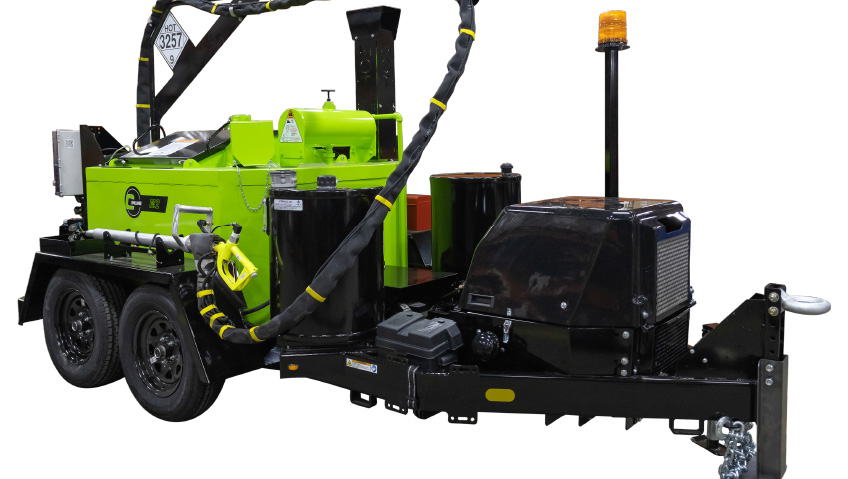
For example, in its M4 crack sealer product, the team wanted to update a pre-existing product for greater job performance, safety, and ergonomics. To do this, it identified four high-use contractors of the specific size of machine being made, then reached out directly to identify areas for improvement. This process, says Thielbar, helps the company broaden its understanding and make sure it is detailing the right areas in its product suite.
The feedback received often applies to areas like use, melt rate, productivity, maintenance, upkeep, and various other issues. By merging this list with original company points, as well as keeping the dealer and end contractor informed of any changes, the engineering team can build the machine through computer-aided design programming. After obtaining final feedback from the advisory council, the pilot unit can be built, after which contractors and dealers are invited to the factory to put hands on the machine and be updated on manufacturing. Finally, the product is introduced to the marketplace.
Product success at this point is gauged based on orders received from participating contractors and dealers. This procedure was undertaken with the previously-mentioned M4 series as well as with the K-series Tack Kettles, and will be used in 2026 for the M1 and M2 melters, the best-selling product in the Cimline catalogue.
Another big driving factor in expanding innovation in technology is safety, especially for those who benefit from Cimline’s products. From road crews to agencies, state departments of transportation, and more, safety is the name of the game. For example, people repairing roadways often must do so in the middle of traffic, and safe procedure involves more than a simple lane closure or a traffic zone. If the company can reduce the number of people on the ground, shrink the footprint of the workspace, and limit overall disruption to traffic and timing—in turn improving operator safety—then it has done its job. Safety is “the main primary focus and directive for where we take our products,” Thielbar says.
He says that currently, the pavement maintenance industry is flat. Thankfully, this was incorporated into Cimline’s projections based on economic feedback from its pavement market as well as other various organizations and programs. There has been a slight decrease in job lettings for the fall season, as well as a tightening in advance of municipal budgets more quickly than in the past. There has also been a decrease in COVID spending as of July 2024, which previously funded about 50 percent of the company’s infrastructure spending through government programs.
Adding up these factors, Cimline goes back to its dealer networks to find out what their supply is, Thielbar explains. These networks are also in the midst of a flat cycle based on sales trends, so the big objective for growth lies not in the municipal or governmental markets but in contractor business, especially because of the cost of interest expense and the reduction in bid-letting in its category year over year. International Sales Manager Matt McCormick says that it has been a pleasant surprise that aspects like tariffs or the weak American dollar have not affected international sales to any noticeable degree.
Cimline’s dealer network is different from that of your typical pavement maintenance manufacturer in that it has both contractor and municipal sales, with the dealer network concentrated on asphalt and pavement maintenance. That focus is then used to educate and train the network and the industry overall. Dealers in the network are up-to-date on the latest training and resources, and are specialists in the asphalt pavement/pavement maintenance industry. This is “not just your average equipment sales company on the end of the street,” says Thielbar.
McCormick points out that growth continues, sales-wise, for Cimline across the globe. Thus far, the biggest market for international growth has been in Latin America, and the company has been fortunate to have developed relationships with quality distributors in markets like Chile, Mexico, Paraguay, and Colombia. Unit sales in Australia have also increased in the past three to four years, and several countries in Europe and Africa also have active representation. It is Cimline’s job to support these distributors in the best way possible with the resources available, wherever the team sees the potential and is able to respond and support its dealers, says McCormick.
A silver lining of being a company in the pavement maintenance arena, Thielbar tells us, is that its swings up and down are not as extreme as those of a mainline equipment supplier. This is generally because of the infrastructure in place that needs to be maintained, and maintenance dollars do not get shifted away as quickly as new construction or replacement dollars do, which will help stabilize the company’s overall market view into the new year. Meanwhile, manufacturing continues to rise and fluctuate consistently, especially thanks to ongoing trends like market tariffs on goods that go into the manufacturing process. While this coincides with Cimline’s annual pricing, it fluctuates at a pace where the end result of inflation input cost is not as extreme as one may think.
Looking ahead to 2026, Thielbar says that Cimline will consistently look to a route of safety and automation, especially as the younger generations continue to step into the pavement maintenance market. McCormick affirms that the company will be picking up a new distributor in the United Arab Emirates in 2026, and that it looks forward to CONEXPO-CON/AGG, taking place in Las Vegas in March. This is the biggest convention for construction equipment in the U.S. market, as it always gets a good international turnout and attracts lots of visitors—including the company’s dealers—for one-on-one interactions.
With so much on the horizon, Cimline has weathered recent storms and looks to make 2026 another exciting and successful year.