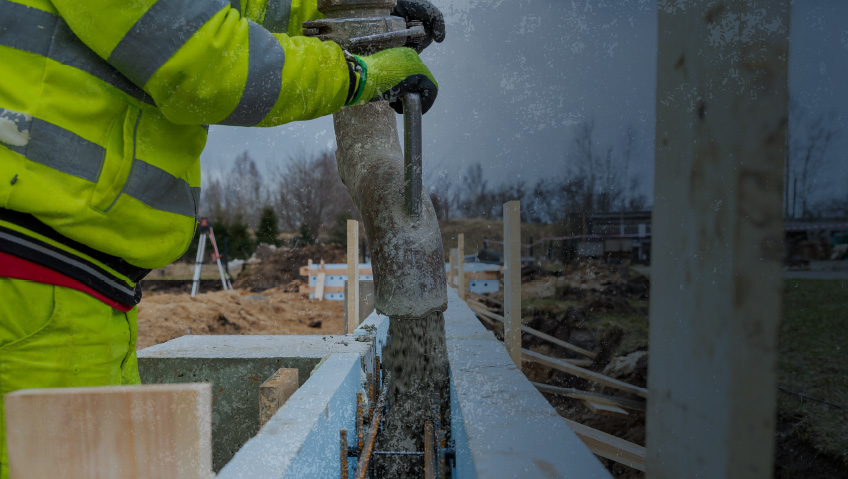
The insulated concrete form (ICF) market is one of North America’s most robust in construction. In Canada, Ontario’s extreme weather makes it the ICF construction capital, while the method’s wind resistance also makes it popular in Florida and elsewhere in the United States, with one house in Mexico Beach having survived Hurricane Michael in 2018.
With a four-hour burn rating, high water resistance, and the ability to withstand 250 mph winds, one can see why this method is becoming increasingly popular in response to climate change. As they also offer significant noise reduction, ICFs are ideal for high-traffic areas and highly populated urban centres.
These are all reasons why Habitat for Humanity is pro-ICF construction in the Oklahoma region and beyond. “Insulated concrete form homes have built-in protection from tornado and wind-related damage, wildfires, and earthquakes—all of which are known to affect Oklahoma,” reads the organization’s Rose Rock website.
Owing to these characteristics, global indicators for the sector are impressive. Intel Market Research noted in September this year that the world’s residential market for ICFs was valued at USD 655 million last year. Moreover, by 2031, it is predicted to reach USD 994 million. With reports by ICF Today indicating figures as high as 26,400 to 41,250 homes built using this method between 2022 and 2025 in the United States and Canada alone, the adoption of this technology has been long in the making.
The first ICFs were Durisol blocks, a product introduced to the construction industry by Swiss innovators August Schnell and Alex Bosshard in 1937. This came before the onset of WWII, registering the patent in Holland in 1932. The innovation is said to have been spurred by the need for fast, mainly unskilled construction to provide for the urgent housing needs of people following the geopolitical ravages of WWI which left many homeless and countless cities in complete disarray.
Originally made from wood fiber suspended in a cement substrate, Durisol would be followed by its next iteration, expanded foam-based ICF, in 1966, when Canadian contractor Werner Gregori was awarded his patent in March of that year. Gregori provided his chemical innovation with a wire mesh that added a level of fire safety. Whether made from recycled wood or polystyrene, these hollow blocks are stacked, much like toy blocks, reinforced with steel rebar and concrete, and finished according to design requirements.
With pollution an ever-present problem, using polystyrene soon became a growing problem. Today, in a world where environmental safety is a growing concern, it is heartening for those looking to lighten their environmental footprint to discover that wood-fiber ICFs are still actively fabricated and used in North America. The most notable manufacturer remains the original, Durisol, which is now selling the product under the Nexcem brand. As a purely recycled waste-wood alternative to chemical-based blocks, these affordable blocks offer high performance and durability while being energy-efficient, insulating, and structurally sound. They are based on the original wood-and-concrete mixture better known as Woodcrete these days, and experts cite breathability and lightweight strength as just two of the material’s other attributes.
Whichever material is used, there are a few pluses to using this method. Firstly, it is fast. Secondly, building with ICFs gives homeowners confidence that the final structure will rate well in thermal bridging, air-tightness, and, as a result, insulation. Price naturally also enters into the equation. Costs can vary depending on the finishes used, so it is not a given that building with ICF is always cheaper. What can be cheaper when executed correctly, however, are such buildings’ operational costs following construction, with their utility bills reported to be lower due to higher insulation levels.
While polystyrene has its benefits, its negatives are considerable and therefore important to consider. Due to the high costs involved in the process, polystyrene is rarely recycled. In fact, the sole company in the United States that chemically recycled polystyrene, breaking it down into its simplest form, Regenyx, shut its doors at the end of 2024 after successfully achieving the objectives defined in its five-year formation agreement. Now, only a few facilities remain that handle the process mechanically and sell the material on to firms in need of packaging and other applications.
The material is also known for not biodegrading but rather turning into microplastics that leach chemicals into the environment once such buildings are eventually torn down and dumped in landfills. The material also contains styrene, a chemical proven to cause hearing loss, and memory and concentration challenges, beyond also being a carcinogen. While it may be safely sequestered while encased in concrete, the end-of-life process of buildings that are torn down cannot be ignored and must therefore be seriously considered.
An alternative to wood and polystyrene that comes to mind is mycelium—the fungal networks that mushrooms sprout from. Sylvi Vogel at Open Range Custom Builders believes this could be an ideal solution: “Various studies and tests comparing the thermal properties of mycelium bricks and panels with insulation materials like fiberglass have shown that mycelium has a high thermal capacity, with an R-Value of at least 3 or 4 per inch, and have also found it to be highly fire resistant,” she wrote in an article on the subject in 2023.
Vogel also mentions cyanobacteria, a bacterium that is currently being researched for its potential in creating Earth-friendly bioplastics and foams that could one day help eliminate the toxicity factors presented by styrene.
While products like building blocks that double as decoration are available on the internet, the technology appears to remain prohibitively expensive for commercial use at this point. As adoption grows, however, one can only remain hopeful that this situation will change, making hollow mycelium blocks a commercial construction reality.
And while science catches up with ecological concerns, traditional ICF construction continues. In the meantime, we continue keeping an eye on Earth-friendly alternatives that could help contractors pivot and adapt to new ways of expanding this outstanding, proven building method across the continent and beyond.