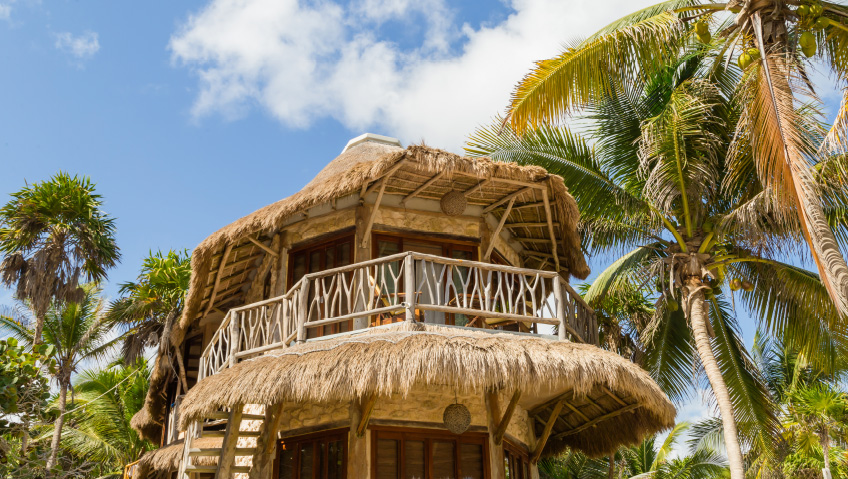
“It’s been a wonderful journey,” says David Sands of the many years he has devoted to the bamboo sector.
While living on Hawaii’s Island of Maui in the 1990s, David Sands, President and Founder of Bamboo Living, built a house for himself. When the lumber was delivered, he looked at the massive amount of wood and thought, ‘This is not a good thing; the guy cut down a whole forest.’ Realizing there had to be a better, more sustainable option to Douglas Fir and other tree species that take decades to grow before they are mature enough to be harvested, he immersed himself in researching bamboo.
Sands soon realized bamboo’s many advantages over traditional building materials like wood, brick, concrete, and even steel. Growing primarily in tropical and subtropical areas, bamboo is abundant in southeastern Asia. Fast-growing and sustainable, it can reach 164 feet in height with a base diameter of 12 inches. Lightweight yet incredibly strong, pound-for-pound, bamboo is a clear winner, used to build everything from small backyard sheds to massive homes. And, along with its versatility, beauty, and sustainability, bamboo is famous for its efficiency as a carbon sequestration and storage system; it can store carbon for up to 150 years.
One of the world’s most versatile materials, bamboo can be used to make countless products—inside the home it is transformed into utensils, kitchenware, decorative items, and as a replacement for hardwood flooring. Bamboo fibers are made into fabric which is then used to manufacture t-shirts, socks, underwear, and bed linen.
“I was trying to find an alternative, and that’s when I started the company Bamboo Living in 1995,” Sands tells us. One of his early projects was the creation of a community house made from bamboo. Growing quickly, the company soon became the world’s first certified and International Code Council (ICC) compliant, permit-ready business for bamboo buildings and home furnishings.
Along with Bamboo Living, Sands is behind sister company Rizome, which manufactures clear, defect-free, engineered bamboo lumber boards, veneers, and panels of various thicknesses and lengths. Just as versatile as wood, these bamboo products are durable and fire-resistant, and can be painted or stained to complement any décor.
Since its founding, Bamboo Living has proudly crafted hundreds of stunning bamboo homes and buildings for clients around the globe, and offers a plethora of available home designs, including the Zen Series, the Ohana Series, the Celestial Series, and many more.
On the smaller side of things, Bamboo Living is behind the construction of 10’ x 12’ sheds, garages, and other spaces used for storage, backyard offices, or accessory dwelling units (ADUs). On the larger end, “We are in progress with the two biggest projects we have ever done, and we’re really looking at creating projects that showcase the material in the biggest way possible,” says Sands. One of the company’s current works is a home of around 10,000 square feet in Hawaii.
Although bamboo grows mainly in the heat of the tropics, Bamboo Living can build anywhere; in fact, the company recently had an inquiry about a ski chalet in Alaska. To date, some of the firm’s clients include Sammy Hagar, Golden Globe and Primetime Emmy Award-winning actress Barbara Hershey, producer Jim Gordon, and eBay founder Pierre Omidyar. “Those projects really helped us get exposure for what we are doing, and for others to really see bamboo as an aspirational material, because that’s an important piece,” says Sands. “There are climate benefits, and it makes beautiful structures.”
These climate benefits are considerable; according to the UN Environment Programme, the building and construction sector is the biggest emitter of greenhouse gases, responsible for 37 percent of global emissions. Traditional building materials like concrete, brick, steel, and wood are labor-intensive to manufacture and install, extremely heavy, and costly to transport to building sites. By comparison, bamboo is much lighter and doesn’t need as many vital resources to produce.
Bamboo is Sands’ passion, and “being able to use alternative materials is an important piece of the puzzle,” he says. As public awareness of the need for reducing greenhouse gases increases, he says it is easier today to persuade people to make the move to bamboo than it was 30 years ago.
A lifelong learner and big believer in educating others, Sands often discusses the countless benefits of bamboo as a keynote speaker to audiences around the world. This includes the Asian Development Bank, which operates to encourage economic and social development and to reduce poverty in Asia and the Pacific. Sands says there is a big push toward mass timber, which stores carbon on site in the wood. However, the World Bank, which has the mission “to end extreme poverty and boost shared prosperity on a livable planet,” has projected that the demand for mass timber—if it stays on its current trajectory—will outstrip the global wood supply two to four times by 2055. “So we need other solutions, and bamboo, being the fastest-growing woody plant, is an alternative,” says Sands.
Working with Indigenous partners, Sands has recently taken on one of the company’s most significant projects: ensuring future supply through planting fields of bamboo. Soon, 12,000 acres will be planted in The Philippines, with plans to plant another 12,000. The company has also done some test planting in Florida and is eyeing planting some 500 acres in Hawaii. “There is existing, mature bamboo here in Hawaii, so that can be the feedstock to start,” he says, “but getting the first acreage planted and the pilot mill in place would be great.”
Back in the 1960s and 1970s, forest regeneration was practically non-existent in The Philippines. Large-scale logging deforested massive tracts of land of their native hardwood and bamboo, which weren’t replanted. As a result, many of these areas stopped regenerating, and invasive grass took over.
“Giant bamboos are native in The Philippines, and huge areas were deforested, So we are working with Indigenous communities, who have finally gotten title to their ancestral lands, and helping them reinforce their homelands,” Sands explains. “That has had a major impact socially as well. Basically, we are able—through current credit funding—to give those plants, pay them to plant the plants on their land, maintain the plants, and create an agreement on when the bamboo matures, so it ends up being multi-generational income for the communities. The plants can live 100 years, and they become a real asset for the community as well. So we are really working to help that along.”
Results of the initial planting have been spectacular. “When you put bamboo into an agricultural setting, we’ve seen as much as 35-foot tall plants in 15 months, so that’s pretty incredible,” Sands says, adding that there is also a group looking to plant 100,000 hectares over the next few years.
Sands has always shared his knowledge about bamboo and its many benefits, and over the years, has been awarded for his groundbreaking work. Last year, Rizome and Sands were honored with the 2024 Secretary of State’s Award for Corporate Excellence (ACE). Presented by the U.S. Department of State, Rizome was one of just six recipients chosen for the prestigious award in the Climate Resilience category.
“This accolade highlights Rizome’s groundbreaking efforts in the construction industry, where they are leading the way in using engineered bamboo as a sustainable alternative to traditional building materials like wood, steel, and concrete,” says the company. “Not only is this innovative material a game-changer for eco-friendly construction, but it also plays a pivotal role in reforesting areas devastated by irresponsible agricultural practices.”
The ACE award, presented for the 25th time, is a symbol of excellence for American companies making a positive impact on the world. During his acceptance speech, Sands’ stated: “It’s no longer business as usual; it’s business as a climate solution and community upliftment, and that’s everybody’s business.” The company was also a runner-up for the XPRIZE Carbon Removal award.
In the coming years, Sands envisions bamboo becoming one of the world’s top building materials, and he himself is tireless in working toward growing the market for this environmentally beneficial, sustainable product, for the benefit of all. “We are really actively working toward that first quarter million acres.”