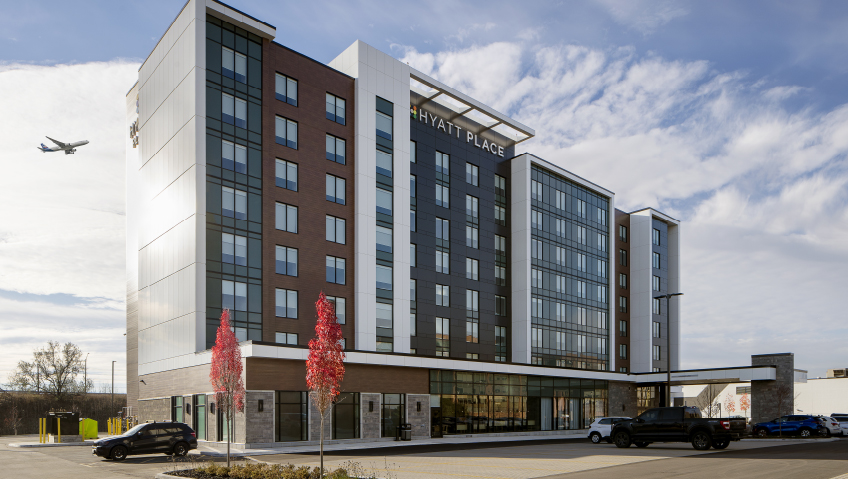
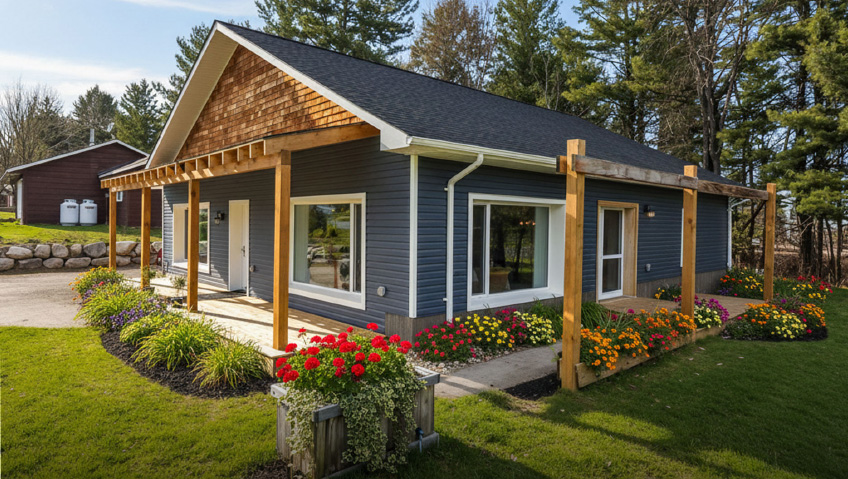
Founded on the belief that the building of a sustainable dwelling should be quick, inexpensive, and accessible to all, Quantum Passivhaus produces certified Passive House panels that reduce energy use by up to 90 percent, are installed in a matter of hours, and ensure consistent, high-quality construction for multi-residential developments, rural communities, and young families.
Located in Minden, Ontario, Quantum Passivhaus prides itself on its prefabricated panels and energy-efficient building design, with construction techniques to help accelerate the North American construction industry’s shift to net-zero building standards.
The company was founded in 2017 by President and CEO, Abby Xerri, and his wife, Angie Horner, Vice President and COO, and the couple’s commitment to sustainability and innovation has created a client-focused company built on empowering people through a collaborative culture that is strategic, hands-on, and deeply invested in making “green” building accessible.
“They make a really good team,” says Eddie Faria, Head of Marketing. “Together they’re a good synergy of people.”
Xerri’s extensive construction background coupled with Horner’s passion for sustainability resulted in embracing Passive House construction as the way forward. “It was a good marriage of both their skills,” adds Faria. “They’re big on the Passive House principles, energy savings, and building in a way that’s future thinking, while also seeing the pitfalls of traditional construction methods.” With rising energy costs and the onset of tighter constraints and building codes—along with keeping in mind Canada’s 2030 net-zero goals—this was the perfect venture to tackle, he says.
Quantum Passivhaus analyzes construction needs at its factory in Minden, where it builds panelized walls that meet the absolute highest criteria of energy sustainability achievable in the world at two different levels: net-zero ready and above, and Passive House, the absolute best. “Three of our panels are Passive House certified, and in terms of sustainability, we’re not only focused on energy conservation, but also just green building in general,” says Faria.
Because Quantum can build panels in a factory and ship them to the site, there is far less site waste compared with conventional construction, allowing the company to construct on even rural sites with a minimal environmental footprint. “We’re really conscious of not disturbing the surrounding environment in a build site,” says Faria. “A lot of our clients appreciate that.”
In fact, much of the decision-making in terms of going with a Passive House stems from conscientious clients who don’t want to disturb the natural environment, and Quantum is able to mitigate that impact, a huge bonus in terms of energy costs. While perhaps not as noticeable—yet—in larger cities where natural gas is affordable, in rural communities, fuel sources can be much more prohibitive.
“Passive House just makes sense in terms of where the future is going, because the building envelopes are so airtight and well insulated that even a home up north loses very little heat,” Faria says. “The systems required to heat it are so minimal and highly efficient, there’s very little energy waste.”
Quantum, he adds, is focused on conserving as much energy as possible in the building envelope. Panels built in the factory are precision-engineered, whereas stick building adds to the framing time and risks exposing the building envelope to the elements for weeks or months on end. “Ours are precision-engineered and thoroughly tested before they go on to the site and are installed. Additionally, Quantum panels have minimal embodied carbon in them.”
While a Passive House purchase seems a natural—and smart—choice these days, education of both builders and the general public remains challenging in terms of cost, affordability, and benefits, both now and for the future. “It’s not really widely well-known yet. There’s still a lot of education that needs to happen in this space,” Faria says. “People hear Passive House and think it’s very expensive and only for people who have a lot of money. That’s just not the case, especially with panelized construction.” Quantum can assemble on site within a three- to seven-day span, which reduces costs and trade coordination in erecting the building envelope, making projects on par with standard construction.
“People don’t know enough about it, and some traditional builders are wary of it because it’s a completely different building methodology,” Faria says. “You have to think about airtightness first and getting a tight building envelope; that’s the priority. With all the techniques that come along with that, for traditional builders, there’s a bit of intimidation in terms of the learning curve and how to properly install Passive House.”
However, interest is rising as building codes keep tightening and energy costs go up, he adds, with more conversation now around energy efficiency and green building. And whenever Quantum does work with interested builders, the company trains them on site in how to properly install the building envelope.
“Expansion is definitely on the horizon,” Faria says of Quantum’s capabilities. “It’s a very exciting time for this because we’re seeing an increased interest, so it’s forced us to grow as a company pretty rapidly.”
Interest and education, of course, start with Quantum’s employees themselves, and how quickly they realize the benefits and advantages of Passive House building. “I learned as I worked here, and the light bulb came on. When I build my house, I’m definitely going to build this way. You get excited about it because you start seeing that this is a really high-quality product. They’re onto something here, especially on the panelized side of things and the speed and the efficiency at which construction happens. It’s really game-changing.”
Quantum’s panels comprise a floor, wall, and roof system, with all components built right in its factory, precision-engineered to a certain thickness that meets Passive House standards. Top quality material in terms of airtight layers and the membranes used ensures that moisture passes through the wall efficiently.
“The best way I can describe it is like Lego® pieces,” Faria says. “We build the pieces in the factory, and then we assemble a building on site using a crane so it goes together very quickly, again, because it’s essentially built in a factory beforehand.”
That being said, there is an extensive plan made out well ahead of time, he stresses. “This is a very technical field. There’s a lot of science and math that goes into everything we do compared to a normal code-minimum home. It’s very precise in terms of the calculations that go into a highly energy-efficient home.”
But the results are nothing short of amazing, he adds, with a focus on the end user’s comfort and overall experience. “A lot of what we’re hearing is the comfort aspect,” he says. “When you walk into one of these homes, you immediately feel a sense of deep peace because of how quiet it is, how much external noise is eliminated because of the quality of the insulation. A lot of our homeowners say that, when they have guests over, people sleep really peacefully.”
The air quality, he adds, is exceptional. “You get really high oxygen content, so you just feel good in the house—you’re able to concentrate longer and it’s dust-free. I’ve walked into four different homes, and the experience was immediately the same in every single one of the homes.” Every room is consistent in temperature and comfort, with no temperature swings and a “substantially” lower monthly energy bill owing to the combination of all Passive House principles.
“Owners are really impressed with how efficient the home is in terms of costs. We had a giant ice storm last year that knocked out the power in our area for about five or six days, and people were scrambling for generators; their homes were immediately cold. But in Passive Homes, people lost maybe three degrees over the course of six days.”
As time goes on, people will realize we’re all going to need these at one point and that they make the most sense, he adds. “That’s why it’s exciting to be in this field, because we can see the trajectory going in that direction as energy costs rise and code tightens.”
Faria—and the entire Quantum staff—works by the philosophy of CEO Abby Xerri, he adds, which is, ‘Everybody should have this.’ “At Quantum, we want everyone to have these homes. It’s not an elite-tier thing that only a certain demographic can afford,” he stresses. “Our goal is to make this available for everybody, and that’s why we also focus on those sustainable developments and affordable housing.”
The company also partners with and works closely with NRCan, with many of its panels going through rigorous testing in their envelope testing facilities. “They test how long our panels can sustain the wind and rain. They have facilities to do that,” Faria explains. “We work really closely with the government to develop the best possible product we can to help meet those energy goals in the future and rising energy goals in Canada.”
And it is the company’s panelized applications that help make its Passive Houses as accessible as possible, Faria stresses. “Not a lot of people know about the panelized approach and how it can save money down the road,” he says. “If you’re building a home you’re going to potentially stay in for the rest of your life, why not look at Passive House, which is the highest building standard in the world in terms of energy efficiency, and do it right? As energy costs rise, build a house that’s actually going to help you out in the future.”