When Steelwrist entered the North American market in 2017, tiltrotators were still considered niche equipment. Contractors were curious but often unsure whether the technology justified the investment. Fast forward to today, and Steelwrist is no longer testing the waters; it is building manufacturing capacity, expanding its workforce, and preparing for the next phase of growth across the Americas.
As the company marks its 20th anniversary, Steelwrist’s evolution offers a clear case study in how disciplined product development, vertically integrated engineering, and market patience can reshape adoption curves in construction equipment. Steelwrist’s story began the way many industrial success stories do: small, focused, and engineering-driven. Founded in Sweden two decades ago, the company started with a narrow mission to develop robust, efficient tiltrotators that improved excavator productivity without compromising machine performance.
That focus has remained intact as the company scaled globally. “This company technically started out of a garage like some other big businesses, and now we’re in multiple entities around the world, with a massive facility in Rosersberg, Sweden, which is our main corporate headquarters,” says Peter Gaj, President of Steelwrist for North America and Vice President of Steelwrist Global.
Today, Steelwrist operates in more than 20 countries, with Sweden still anchoring product development, engineering, and casting expertise. Rather than outsourcing core systems, the company made a deliberate decision to build an in-house ecosystem. Steelwrist acquired SVAB, its control system and joystick manufacturer, and a bucket and attachment manufacturer, bringing hydraulics and electronics under one roof. That integration is not a branding exercise; it is operational leverage. Engineering teams work directly across product lines, enabling faster iteration and fewer compromises between mechanical, hydraulic, and digital systems.
Steelwrist formally launched its North American entity at the end of 2017, beginning operations in 2018 with a single employee and a small facility in Berlin, Connecticut. At the time, tiltrotators were well established in Europe but still unfamiliar to most U.S. and Canadian contractors. The company anticipated slow adoption and planned accordingly. “Europe is often ahead of North America when it comes to technology… Tiltrotators are very big in Europe. Now they’re starting to gain traction here, and we’re starting to see double-digit gains each year,” says Gaj.
The comparison mirrors earlier adoption cycles for machine control and 3D GPS systems. What was standard in Europe for years eventually gained traction in North America once contractors saw consistent productivity and fuel-efficiency gains. Steelwrist used that time to educate dealers and refine its product lineup for North American jobsite realities. Landscaping contractors were among the first to see value, followed by utility, site work, and now demolition and mid-size machine segments.
By late 2024, the growth curve justified a major leap, and Steelwrist moved from its original 15,000-square-foot facility into a 90,000-square-foot building in Newington, Connecticut, expanding both warehousing and assembly operations. But the most consequential step in Steelwrist’s North American strategy is manufacturing. In February 2026, the company will officially inaugurate a new manufacturing operation at its Connecticut facility, dedicated to producing equipment specifically for the U.S. market, a move that addresses one of the biggest friction points in heavy equipment purchasing: lead time.
“This U.S. market doesn’t accept a 12 to 13-week delivery time; they just go to the next person in line,” says Gaj. Previously, equipment built in Sweden required weeks of production followed by ocean transit. While acceptable in some markets, that timeline clashed with North American contractors accustomed to near-immediate availability.
Localized manufacturing changes that equation. Faster delivery improves customer satisfaction and allows Steelwrist to scale without relying solely on transatlantic logistics. Over time, the company expects the Connecticut operation to expand in capacity, with long-term plans that include a future West Coast presence as demand grows.
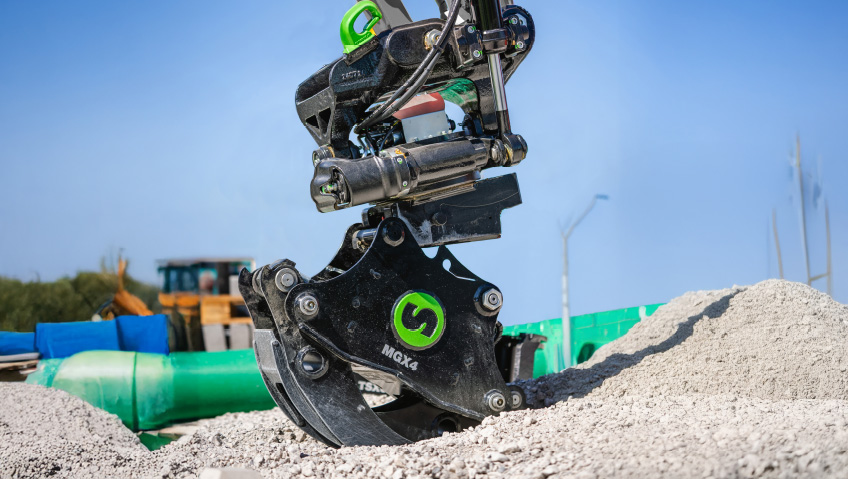
At the core of Steelwrist’s product performance is its use of steel cast components rather than traditional fabricated steel assemblies. The distinction matters, particularly at the end of an excavator stick where every kilogram affects breakout force, stability, and fuel consumption. “When you start putting couplers and tiltrotators on the end of a stick, you’re adding weight, and that impacts breakout force and digging performance. Steel casting lets us reduce weight while maintaining strength,” Gaj explains.
Steelwrist’s steel cast components retain weldability, ensuring serviceability in the field. The reduced mass improves machine balance and minimizes the cascading performance losses that occur when attachments grow heavier. This design philosophy supports the “sandwich” configuration many contractors prefer—a quick coupler on top, a tiltrotator in the middle, and a second coupler below, without overloading the excavator.
One of Steelwrist’s most anticipated recent developments is the SQ40 fully automatic quick coupler, designed for smaller excavators in the important four to six ton segment. Its release completes Steelwrist’s fully automatic coupling range from SQ40 through SQ90. The SQ system allows operators to change hydraulic attachments without leaving the cab. Hydraulic connections engage automatically, eliminating manual hose handling, reducing oil spills, and significantly cutting changeover time. “What the SQ system does is save time, save cost, and eliminate the need for someone on the ground changing hoses. It’s safer and more efficient,” Gaj explains.
In demolition, the impact is even more pronounced. Contractors traditionally bring multiple machines to a site, each dedicated to a single attachment, because switching tools manually is slow and labor-intensive. With SQ couplers, a single machine can cycle between breakers, pulverisers, and grapples in seconds. Steelwrist has assigned dedicated resources to the demolition segment, recognizing that equipment utilization, not just purchase price, drives contractor economics.
As attachment systems become more advanced, control complexity can become a barrier, and this is where Steelwrist’s QuantumConnect platform comes in. This system replaces previous control architectures with a simplified plug-and-play setup that reduces installation time by nearly half. Remote diagnostics allow technicians to access fault codes, troubleshoot, and perform over-the-air system updates without physically visiting the machine. “With QuantumConnect, we’ve eliminated close to 50 percent of the parts and install times drop dramatically; it’s simpler, faster, and smarter,” Gaj says.
The platform also introduces new A9 joysticks with enhanced ergonomics, programmable functions, haptic feedback, and heating for cold-weather operation. Combined with the Installmate app featuring machine-specific, step-by-step installation guidance, Steelwrist is shifting complexity away from dealers and contractors and embedding it into the system itself.
While landscaping initially drove North American adoption, Steelwrist now sees demand expanding into mid-size machines and heavier applications. Utility contractors and demolition firms increasingly recognize the productivity gains of tiltrotators paired with automatic couplers. And the numbers illustrate the opportunity. In Scandinavia, approximately 90 percent of new excavators ship with tiltrotators, while in North America, that figure remains near one percent. The gap represents potential, not saturation. “Tiltrotators have been around for 30 years in Europe. Here, it’s only been six, and the penetration rate shows how much room there is to grow,” Gaj notes.
In terms of sustainability, Steelwrist approaches it from an operational standpoint. The company’s position is straightforward: make machines more efficient, and environmental benefits follow naturally. By allowing excavators to work from a single position, tilting 45 degrees in either direction and rotating 360 degrees, tiltrotators reduce tracking and fuel consumption, with Steelwrist estimating efficiency gains of 20 to 40 percent depending on the application. That efficiency translates into reduced wear on components and longer machine life, outcomes that matter to contractors managing rising fuel and maintenance costs.
Beyond its products and facilities, Steelwrist attributes much of its growth to culture. The company operates around three core values: responsive, simple, and fast. “Those three values are the heart of the company, and they guide every decision we make,” says Gaj. The philosophy extends to decision-making authority. Sales and support teams are empowered to resolve issues without navigating layers of management, provided they act in the customer’s best interest. That trust accelerates problem-solving and reinforces accountability. As Steelwrist expands globally, maintaining that culture remains a priority, particularly as local teams take on greater responsibility.
As Steelwrist enters 2026, leadership continuity will play a critical role. Gaj will assume the role of President of Steelwrist North America on February 1 while also becoming Vice President of Steelwrist Global, overseeing operations across North and South America. The timing aligns with manufacturing expansion, new product releases, and increased market visibility at the upcoming CONEXPO-CON/AGG in Las Vegas.
From its Swedish roots to its growing North American footprint, Steelwrist’s trajectory reflects a company that values technical integrity and long-term commitment. At 20 years in, its next chapter is less about proving the technology and more about scaling it responsibly in a market finally ready to adopt it.