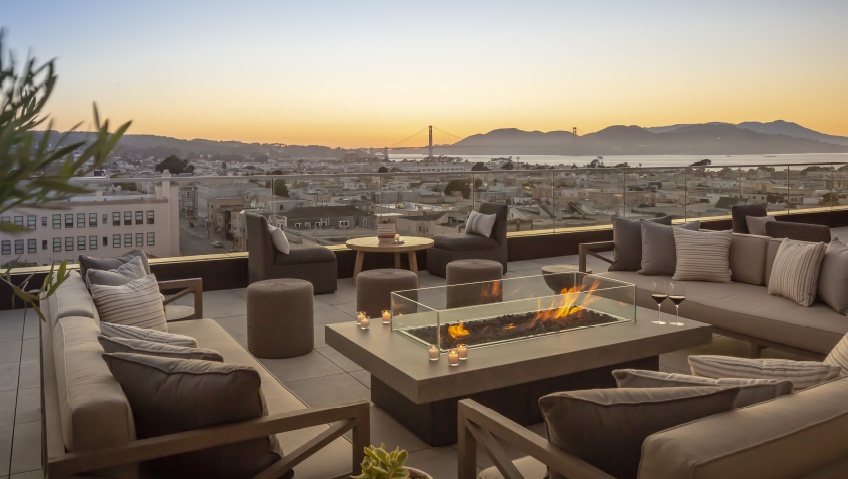
When Mark MacDonald reflects on the founding of DM Development, he traces it back to a serendipitous encounter in 2008 at an Urban Land Institute seminar. Having just graduated from business school, MacDonald had spent years in the high-tech world at Oracle, wielding his Stanford engineering degree in the heat of the dot-com boom. But despite the prestige and innovation of the tech industry, something was missing.
“I wasn’t exercising my passion for design,” he recalls. “Real estate development was the perfect way to combine that love of design with my aptitude for math and engineering.”
At that seminar, MacDonald met Danielle Dignan, an experienced developer already building small-scale projects in San Francisco. Together, they represented a balance of theory and practice, MacDonald with his analytical background and Dignan with her hands-on construction experience. Within months, the pair launched their first project, marking the birth of DM Development, a company now known for merging cutting-edge design with social impact.
The company’s debut project, a modest two-unit building in San Francisco’s Marina District, was conceived just before the 2008 financial crisis hit. “We closed on the property two or three months before the Lehman collapse,” MacDonald says, laughing at the timing in hindsight. What could have been a catastrophic start instead became a defining moment for DM’s philosophy: resilience, creativity, and long-term vision.
Rather than retreat, the partners pressed forward, betting on San Francisco’s recovery. The decision paid off, not only financially, but strategically. Their early success allowed them to scale up quickly when competitors were hesitant, acquiring undervalued properties and developing during a period of low construction costs. By the mid-2010s, the company was being hailed as one of the city’s most forward-thinking developers.
At its core, DM Development has always been about more than just building structures. It’s about building community, beauty, and opportunity across the economic spectrum. The founders saw a gap in the housing market—stunning design and quality craftsmanship were typically reserved for high-end buyers. They wanted to change that.
“Our goal has always been to democratize great design,” says MacDonald. “We want to make it available not just to the wealthy, but also to middle-income and affordable housing residents.”
That ethos has shaped every DM project since. Whether developing ultra-luxury condominiums or affordable housing complexes, the company maintains the same standards for materials, finishes, and amenities. Each project embodies what MacDonald calls “uplifting spaces,” homes that improve the quality of life for residents while enhancing the fabric of the neighborhood.
As a result, DM Development has become a leader in pushing the boundaries of construction technology, particularly in volumetric modular design and mass timber. These methods, once considered niche, are now central to the company’s efforts to deliver housing that is both affordable and environmentally responsible.
Volumetric prefabrication, for instance, involves manufacturing fully built modules offsite and assembling them like building blocks at the construction site. This method dramatically reduces waste, cuts down on carbon emissions, and shortens construction timelines.
“Volumetric modular can reduce construction waste by up to 40 percent,” MacDonald explains. “You’re building much like you would a car in a factory, with precision, efficiency, and far less environmental impact.”
Likewise, mass timber—large, engineered wood components that replace steel or concrete—offers both aesthetic and ecological benefits. Timber captures carbon, supports sustainable forestry, and creates warm, inviting interiors that residents love.
One of DM Development’s most ambitious undertakings to date is 300 De Haro Street, a project that’s setting a new standard for affordable housing in San Francisco. The 11-story, 425-unit development is one of the largest 100 percent affordable housing projects ever built in the city, designed to provide homes for residents earning between 30 and 70 percent of the Area Median Income (AMI).
The project was initially conceived as a market-rate development, but when financing became difficult amid economic headwinds, DM pivoted. By leveraging low-income housing tax credits and tax-exempt bonds, the company was able to move forward, and in doing so, address one of the city’s most urgent needs.
“We’re building this project for about $500,000 per unit,” says MacDonald. “In San Francisco, it’s not unusual for affordable housing to cost over a million per unit, so to deliver something of this scale and quality at half that cost is incredibly exciting.”
Every unit, amenity, and public space at 300 De Haro has been designed with the same attention to detail that defines DM’s luxury projects. “We’re not building affordable housing; we’re building beautiful housing that happens to be affordable,” says MacDonald. It’s a statement that captures DM’s mission perfectly: housing should be functional and inspiring, regardless of income level.
For DM Development, architecture is only the beginning. The company believes that what happens inside the walls of its buildings—the connections formed, the sense of belonging—is equally important. Many new residential buildings boast high-end amenities, from fitness studios to rooftop lounges. But MacDonald notes that these spaces often sit empty. DM’s approach focuses on activating those spaces through thoughtful programming and human connection.
“We don’t just design beautiful amenities; we create experiences,” he says. “That starts with hiring the right people at the front desk, people who are warm, welcoming, and know residents by name.”
Concierge staff are trained to foster relationships and anticipate needs, whether that means helping with errands, recommending local restaurants, or hosting events that bring residents together. These gatherings, yoga sessions, shared meals, and wellness workshops turn a building into a true community.
Inclusivity is another central tenet of the firm. Many DM projects integrate mixed-income housing, where luxury and affordable units coexist. It’s a model that some doubted would work, but the results have proven otherwise. In fact, many residents have expressed appreciation for the diversity it brings to their communities.
The rise of remote work has also reshaped the housing landscape, and DM Development is responding with innovation once again. The company is developing a new model that blends hospitality and multifamily living, with flexible, fully furnished rentals designed for today’s mobile workforce. Coming out of the pandemic, the team saw a surge in “digital nomads,” professionals who could live anywhere and wanted flexibility without sacrificing comfort. At the same time, the concept of “bleisure” (business + leisure) travel was gaining traction, with people extending work trips into longer stays.
“People don’t just want a hotel room anymore,” says MacDonald. “They want a beautiful, flexible home, a place that feels personal, even if they’re only staying for a month.”
DM’s flexible living concept offers fully furnished apartments available for stays ranging from a single night to a year or longer. The units are efficiently designed, with adaptable furniture and integrated technology, allowing residents to personalize their space. This model not only meets a growing demand but also creates stronger financial returns for investors through higher rent premiums and greater occupancy flexibility.
The company’s first project in this category is underway in Boston, chosen for its mix of universities, hospitals, and transient professionals, a perfect match for the flexible living model. Plans are already in motion to expand the concept to other major U.S. cities.
While DM Development continues to explore innovative housing models, its heart remains in California, particularly in addressing the state’s housing shortage. Following the success of 300 De Haro, the firm is doubling down on affordable housing throughout the Bay Area and beyond. The company is evaluating new projects in Oakland, Walnut Creek, Mountain View, and San Jose, as well as in Southern California markets like Los Angeles and San Diego. Even Beverly Hills, a city known more for luxury than affordability, is now on DM’s radar as it seeks to meet new housing requirements.
For MacDonald, this expansion represents both an opportunity and a responsibility. “It’s incredibly gratifying to deliver 100 percent affordable housing in the same markets where we’ve built luxury properties,” he says. “It shows what’s possible when design, efficiency, and purpose come together.”
DM Development’s ability to adapt and thrive in challenging conditions stems not only from vision but also from policy awareness. The company has been quick to leverage California’s evolving legislative landscape, using tools like SB35 and the State Density Bonus Law to streamline entitlements and accelerate project delivery. These measures, combined with innovative financing and design strategies, could help unlock thousands of new housing units across the state.
Of course, this team understands that as cities grapple with climate change, sustainability is no longer optional, and DM is approaching the issue holistically. Beyond its mindful use of materials and construction methods, sustainability is built into the company’s entire philosophy: reducing waste, supporting local economies, and designing for human well-being.
Energy-efficient systems, transit-oriented locations, and abundant green spaces are now standard in DM’s projects. But the company goes a step further by integrating wellness and mindfulness into design. From yoga and meditation rooms to hydrotherapy spaces, DM’s communities promote physical and mental health in ways that resonate with modern residents.
“It’s about creating environments where people thrive,” says MacDonald. “When someone feels connected, healthy, and inspired by where they live, that’s when a building truly succeeds.”
Looking ahead, DM Development’s path forward is clear, and ambitious. The firm plans to uphold its dual focus on affordable housing and flexible living, scaling both models across California and into new markets. As the economic tides shift and urban landscapes evolve, DM remains anchored in its founding principle: great design should be for everyone.
From luxury high-rises in Los Angeles to affordable communities in San Francisco, every DM Development project carries the same DNA: a commitment to beauty, inclusivity, sustainability, and community. It’s a vision that blends the artistry of design with the pragmatism of engineering, much like the man who leads it.
For Mark MacDonald, the transition from high-tech to real estate wasn’t just a career change, but a calling. “I realized that real estate development was what I was meant to do all along,” he reflects. “It lets me combine everything I love—design, innovation, and impact—into something that makes a real difference in people’s lives.”
And in a city where the cost of living continues to soar, DM Development’s message, that beauty and affordability can coexist, feels not just refreshing, but essential.