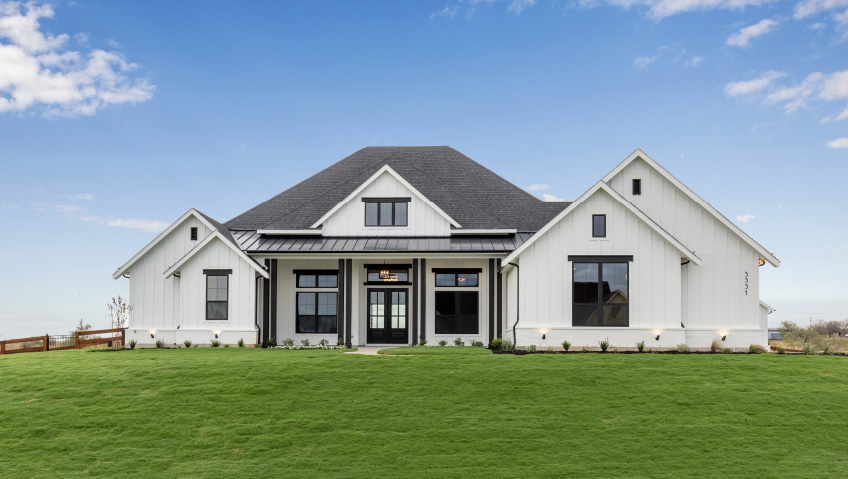
The team at Kindred Homes understands the importance and magnitude of purchasing a home, and they also understand the meaning of family. Regarded as a leader in the Texas homebuilding industry, Kindred provides customers with a place to plant roots, raise children, and make memories for years to come. With a culture deeply ingrained in the concepts of loyalty, quality, and community care, Kindred has built a legacy dedicated to putting family first, and partners Terry Horton, Trent Horton, Todd Miller, and Glen Bellinger each bring unique expertise and a strong interest in the home construction sector.
While it’s been a “roller coaster” of a year in terms of interest rates and economic uncertainty, Kindred Homes has stayed strong in its dedication to offering customers the best service and product, particularly by continuing to provide home personalization. “Buyers have a lot of options, as it’s more of a buyer’s market than it has been in recent memory,” says Roger Lasater, Director of Sales. “You have to sell a product and a service that customers really want, and it’s a great time to buy a house.”
This means superior service that stands out now will end up paying dividends down the road, he adds. The market has shifted, but Kindred Homes has persevered in its ongoing efforts to stay ahead in the Dallas-Fort Worth Metroplex.
Founder Trent Horton attributes much of Kindred’s continued success to its commitment to both customers and employees. “As a family-owned company, we approach every relationship that way,” he shares. “We treat our employees and our buyers like family.”
When it comes to building, Kindred aims not to directly compete with the national volume home builders, instead focusing on larger homesites and select locations. “Some of our communities are structured differently and serve lot types that many builders aren’t able or willing to pursue,” says Horton. “We try to stay a little more custom, at a slightly higher price point, and avoid going head-to-head with the large production builders.”
As part of its upcoming communities, Kindred will introduce a new product line aligned with its long-term growth strategy. “We’re focused on expanding our brand in high-activity neighborhoods where buyers are seeking strong home value,” says Partner Todd Miller. “We’re intentional about where we build and continually refine our product to meet buyer needs and complement each community.”
To support this shift, Kindred is expanding into new communities that include 35-foot lots, creating more attainable entry points for today’s buyers. “As Roger mentioned, it’s definitely a buyer’s market,” adds Miller. “For many families, pricing has made purchasing a new home more challenging, so we’re intentionally broadening our offerings to meet a wider range of needs.”
In addition, new neighborhoods are coming soon to Waxahachie featuring one-acre homesites along with traditional 60- and 75-foot lots, allowing Kindred to deliver a diverse mix of products that align with evolving market conditions and affordability needs.
“We’ve been fairly busy with good opportunities,” Miller shares. “We’re fortunate that we’re getting some good locations for us for the future, and we’re beginning to add, in addition to the 25-foot product, some new 50-foot products we’re excited about. These will give us more options to meet buyer demand that may be missing today.”
Having had more time to design the product with extra thought has been a bonus for Kindred, he adds. “Our entire business has really evolved this year, and our build times have probably improved by 30 days, which is pretty significant. This allows us to deliver our houses quicker and also at a better quality.”
As for strategic direction, although it’s been a down year economically, the company is looking ahead with positivity and an eye to profitable growth and reinvestment. “We’re building ourselves back up and grew about 15 percent this year,” Miller adds.
The company is anticipating similar growth ahead, reinvesting the majority of profits into new land deals, all while experiencing an impressive lower employee turnover. “Most of our team members are celebrating two, five, 10-year anniversaries, which is pretty exciting,” Miller says, adding that it’s imperative to continue to reinvest in the business, move into new neighborhoods, get Kindred’s name out there, and ensure customers know the company is committed to truly deliver the idea of home, whatever that may be for each individual.
During COVID, Horton adds, there was a huge migration of people to Tennessee, Florida, Texas, and the Carolinas, and as people moved, prices pushed up on the finished home product side, the land side, and cost of goods, at a rapid pace. “It will take time to get back on track,” he says.
Beyond housing, Kindred Homes prides itself on its deep dedication to giving back to its community whenever possible. “We’ve always had a charitable drive to us,” says Lasater. “We’ve always given to Toys for Tots, Hometown Heroes for veterans, and this year we participated in the Builders for Babies Diaper Drive by HomeAid where we donated money, time, and resources for diapers for families in need.”
Builders for Babies was the first major project facilitated by the new HomeAid North Texas chapter, which kicked off with multiple other homebuilders across the Metroplex through HomeAid, raising more than $330,000. As an organization dedicated to helping combat homelessness, HomeAid offers programming services and safe, respectable accommodation by utilizing its connections in the building sector to access in-kind labor and material donations.
This year, Builders for Babies recognized the need for more than 28 million diapers in North Texas, with local diaper banks only able to supply just over 10 percent of the demand. “It was a unique experience for our team and our management group to get out there, and it was good to give back,” stresses Lasater. “You can see the impact.”
A positive, community-focused mindset continues to drive Kindred Homes’ success, and maintaining that family-owned culture is what keeps the team moving forward, says Horton. “One of our greatest strengths is our size. Because we’re a smaller, family-owned company, we’re able to adapt quickly, make decisions efficiently, and pivot when needed without layers of red tape. That flexibility allows us to respond to changes in the market and keep momentum on our side.”
In turn, Kindred is able to take those lessons learned, reach out to its customer base, and receive feedback. “This has led to the product we’ve designed and to targeting some of these new areas that are probably underserved,” says Lasater. “It’s something we think we can do really well and, combining that with the ability to personalize a home with that one-on-one service and touch, we’re really excited for the future.”
Additionally, from Kindred’s ownership to its management team, and even some team members, many have worked in the corporate world and have come to understand the importance of being readily available to customers. “It’s the accessibility,” Lasater says. “If you’ve got a legitimate issue, it’s easy to get a hold of us and talk. We can adapt plans and do things a little quicker than some of the big builders can.”
Amidst myriad market shifts, Kindred Homes is still growing, staying the course and looking toward the future. “We want to deliver a quality product and first class customer experience. That’s not just a company slogan; it’s a commitment from our family to yours and something all of us at Kindred Homes make a priority.”