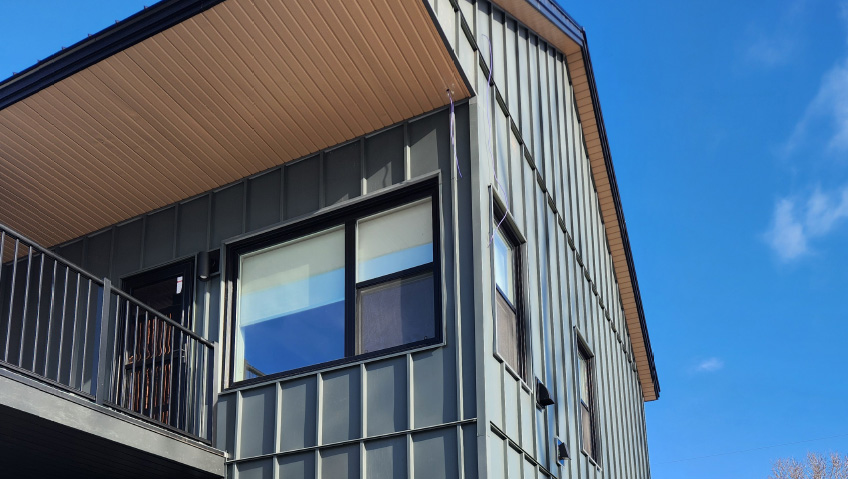
“When Troy and I met, we saw the need to tackle affordable housing,” says 720 Modular Partner and Vice President, Project Development, Craig Mitchell of Troy Ferguson, Founder and CEO. “We had an opportunity to team up the yin and yang of what we’d learned in modular construction in Western Canada and bring it to other areas of Canada.”
The duo, who honed their craft over decades of building and managing distinctive, reliable, and remote modular solutions for the North American resource sector, now construct new multi-family housing, staff housing for businesses, and shelter accommodations for the homeless, made possible by the growing supplier presence and expanding capabilities in today’s modular industry.
Specializing in providing clients with a full turnkey solution that takes their modular building project from conception and permitting to installation and occupancy, 720 Modular works directly with owners, providing a group of architects, consultants, modular manufacturers, and general contractors to speed up construction and produce projects at a reasonable cost.
“Our passion for our business is really about acting as the quarterback between traditional onsite construction, building things that everybody knows how to do in the industry, and being the conduit to more innovative offsite construction,” adds Ferguson.
Creating more affordable housing across the country is a high priority, and one they both strive to provide for families that need a hand. “Craig’s the technical side of the business wholeheartedly, and I’m more the vision of what can be done that we can bring together,” says Ferguson. “We help owners, manufacturing facilities, and local general contractors better understand each other.”
Quarterbacking all these efforts includes bringing together design (the architects and the engineers) and the factory, which shoulders the lion’s share of the off-site construction. There is also the transportation of modules from the off-site manufacturing facility to the on-site project location, and the assembly crew, which encompasses crane operators and the individuals who fit the modular pieces together, connecting them and ensuring they’re weather-tight. Finally, there is the site general contractor who prepares the site as they would for any building. Once that happens, assembly is quick.
“They step in and finish what I like to call the wrapping paper,” says Ferguson. “They put cladding on the building, finish the roof package, whether flat or peaked, and do all of the connections inside. They do the landscaping and parking, and then we hand the keys over to the owner.”
Smoothly integrating all of those key players in a project is vital, he adds. Each of those different people on the team is often used to working in silos within their respective areas under a traditional construction model, whereas modular construction demands clear communication and collaboration.
“Really, that’s our strength,” Mitchell says. “Troy and I have both seen projects fail in the modular construction world because no one has been quarterbacking that process. People think modular construction is another tool in your toolbox, another form of construction, but the process of modular construction—how well you’ve coordinated a project—is where projects are won or lost.”
To that end, 720 Modular believes that modular construction won’t gain traction in Canada unless it’s well coordinated, which is where the company shines.
Over the last 50 years, modular construction in Canada has been largely synonymous with single-family modular housing, trailer parks, and industrial workforce camps; it’s only in the last decade that it has been seen as a method of construction that could solve some of the existing labour issues in construction. Now, modular is enjoying an uptick, particularly in the affordable housing sector.
“We’re in the volumetric modular business, so 3D if you will,” Ferguson explains. “Modular versus prefabrication are different. We actually build the entire unit to a finished state, primarily in the factory.”
The team’s work in the mental health sector is a particular source of pride, with their first project a four-storey apartment building with commercial space for the Canadian Mental Health Association in Charlottetown, Prince Edward Island, which then led to a second building. “Craig and I are true believers in supporting Canadian mental health,” Ferguson shares. “We both have experienced family mental health challenges firsthand so we’re passionate about that.”
The company is also dedicated to taking “idle assets” and turning them into homeless shelters or seniors’ transitional housing. In fact, 720 Modular is now on its eleventh project repurposing western Canadian used energy sector assets in eastern Canada, Ontario, and Prince Edward Island, adding several hundred beds.
“We’re intent on trying to develop that local knowledge as well, and we rely on the local boots-on-the-ground people to assist us in every region,” says Mitchell. “Our focus has been to develop an Atlantic Canada team and an Ontario team, and eventually we’ll have a Western Canada team. It just so happens that we’ve got traction in Atlantic Canada, so that’s really where we started.”
Everything’s better when you’re on a team, he stresses. “Traditional construction always has been building one project, and then the team goes their separate ways, another project comes along, and you try to bring a team back together. That’s not an efficient way to build buildings. We’re taking the team approach and developing a body of knowledge amongst each of these individual people, so the whole is going to be greater than the sum of the parts. We’re aiming to build buildings faster, and we’ve proven it can be done.”
In fact, the design team for 720 Modular’s second project with the Canadian Mental Health Association worked 30 percent faster than the first project because they knew each other, had some standardized designs, and turned over the project in less than 12 months from start to finish.
“We really believe in the team approach to building projects and scaling housing in Canada,” says Mitchell. “Ultimately, we don’t want to just do one-off projects; we’d like a stream of projects. We’d like a portfolio of owners who say, ‘We value this type of construction. Let’s not just build one project—let’s build 50 projects.’”
Pondering 720 Modular’s success and lessons learned, the word “trailblazing” comes to mind. From an operations standpoint, the modular sector in Canada as a whole is still very much behind other areas of the world. 720 Modular is striving to kickstart the industry by bringing multiple players along on that journey to build capacity. And there are role models to be found, such as Sweden, which is 20 years ahead of Canada in off-site construction.
“80 percent of the homes in Sweden are built in a factory, and we do less than 5 percent here in Canada, so we’ve got a long way to go,” says Mitchell.
The company is learning, he adds, making a series of mistakes along the way, but always learning from them and coaching team members to get better. “We’re bootstrappers,” says Ferguson. “My value proposition in our organization is to see the value, to bring the pieces together, and to understand what type of acumen and character we need to help teach people to think a different way.”
Trailblazing also means cultivating confidence in the industry and teaching as many people as possible. “We’re not here to cover the entire market. We’re here to be a piece of it and to share what we know. We can do it way faster and at a better price point so that all of our kids can actually own a home or, at the very least, have a decent life without rent consuming more than 50 percent of their take-home pay,” says Ferguson.
While one of the company’s biggest challenges will be finding employees with the skill sets needed to perform modular construction properly, this is also an opportunity to grow the team’s mentality, direction, and strength. 720 Modular’s success with Canadian Mental Health is one example of the team flexing those muscles, and in the coming 12 months, the company will crest the 200-unit mark in new, social, affordable housing—an exciting milestone—and will be working on its second First Nations project.
“There’s social good in the work we’re doing,” says Mitchell. “You don’t often get that in your career. You’re sometimes punching a clock or wondering why you’re in a business. This is tangible. We get to see the people actually housed in our units, and you realize you’re making a difference. From a success standpoint, that means a lot. We don’t often get that in our career.”
For Troy Ferguson, this is more than just a successful business: it’s a truly personal project stemming from some tough childhood experiences. “I grew up in Ontario housing with my sister and my single mom, a little bit ashamed of where we lived, to be honest,” he says. “You grow up in a small town and you’re the family that lives ‘over there.’ It always stuck with me, and I was lucky to get educated and find my place in the world and try to do some good.”
While financial success is important to be able to continue the work, what differentiates 720 Modular is the team’s ability to inject pride into the places it creates for people in these social housing environments.
“I personally believe if you love where you live, you just love yourself better,” stresses Ferguson. “We’re hoping we can give people a nice place at a lower cost for everybody. That’s our goal, and I think it’s a differentiator to give people some hope, give those kids some hope, so they can go on to do some good for the country.”
With that comes creating a playbook, he adds, one that the company must work on every day. “How are we going to add to the book? This book is going to be valuable to everybody else in the country, and we’re going to be happy to share it, and that makes us feel good every day at work.”